Most mornings I take Dexter out into the woods at the top of our street. Dexter is a dog — a very good one, as it happens — and he is entirely unaware that the walk is doing him clinical good. He is simply a dog in some woods, which is about as present as any living thing can be.
I try to meet him there. Present with him. His walk, not my walk — which sounds like a small distinction but is actually the whole practice. When you are walking someone else's walk, you stop rehearsing your to-do list. You stop catastrophising about the consultation you have at eleven, the blog post you haven't finished, the VAT return. You start, instead, to notice things.
At the top of our street there is a conifer — taller than a two-storey house, completely out of scale with everything around it — that I think is genuinely magnificent. I notice it most mornings and it still surprises me slightly. A few steps further and the path narrows and darkens into a break between the trees that looks like a wee secret tunnel, the kind a child would run through without hesitating.
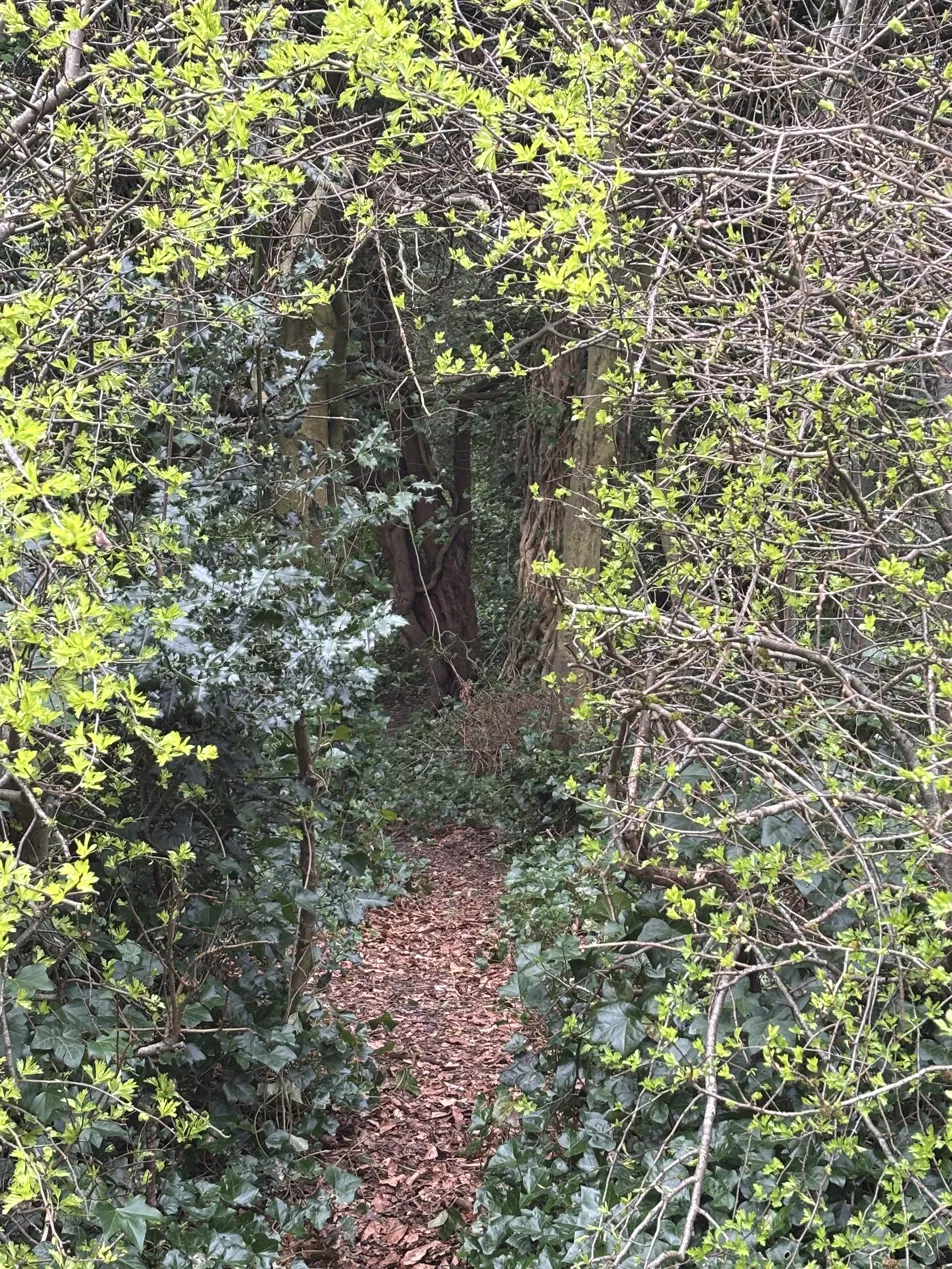
The break in the trees at the top of the street — dark enough to feel like an entrance to somewhere else entirely
In the summer the rhododendrons come into full purple bloom on both sides of one particular path — intense, saturated colour in a Scottish wood that is mostly grey and green. Later in the season the wild raspberries and brambles grow along the same stretch, and if you are paying attention — and if you are reasonably confident no dog has been by recently — there are dandelion flowers along the verges that are worth eating.
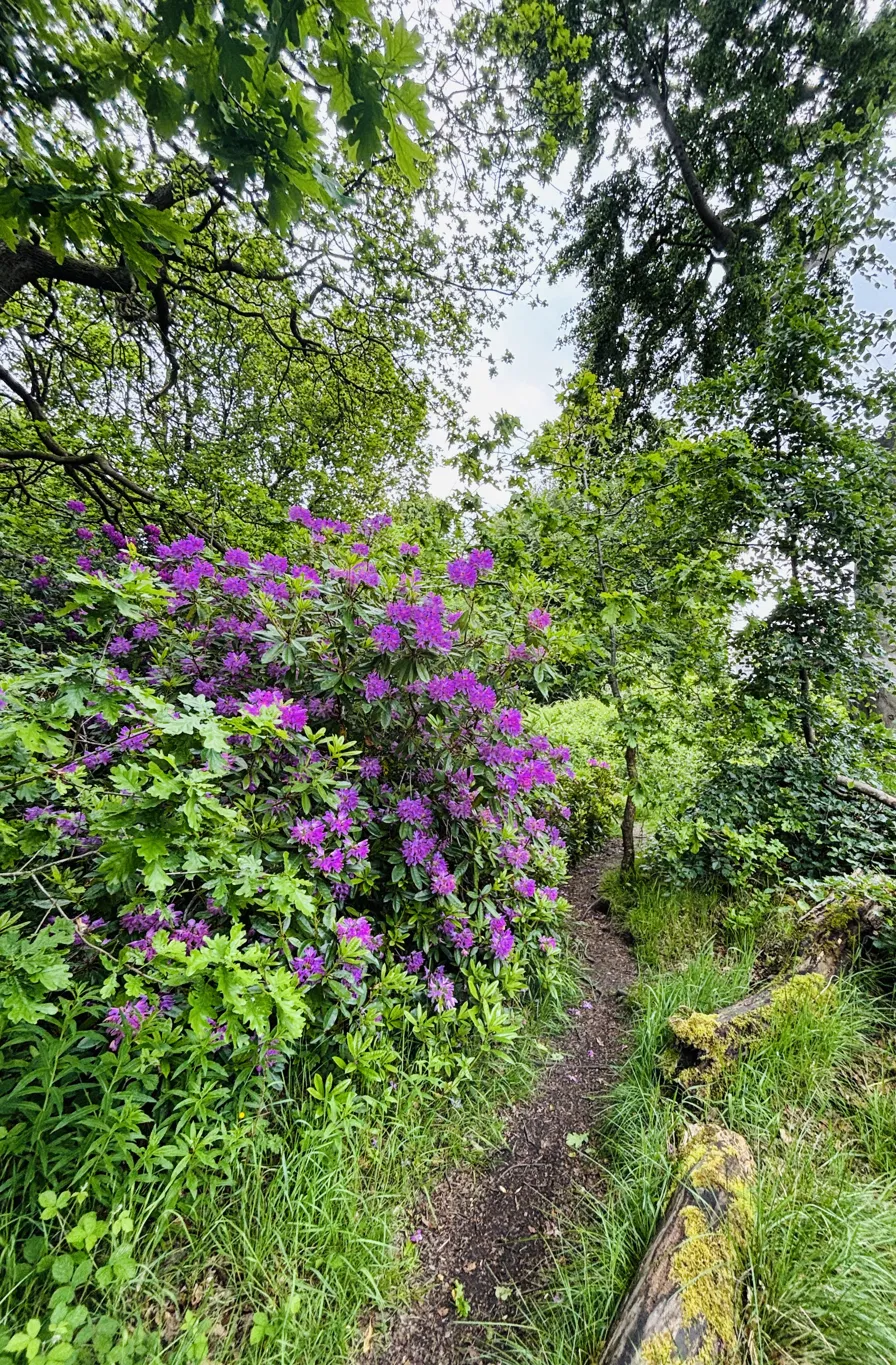
The rhododendron path — the same walk, every morning, never quite the same twice
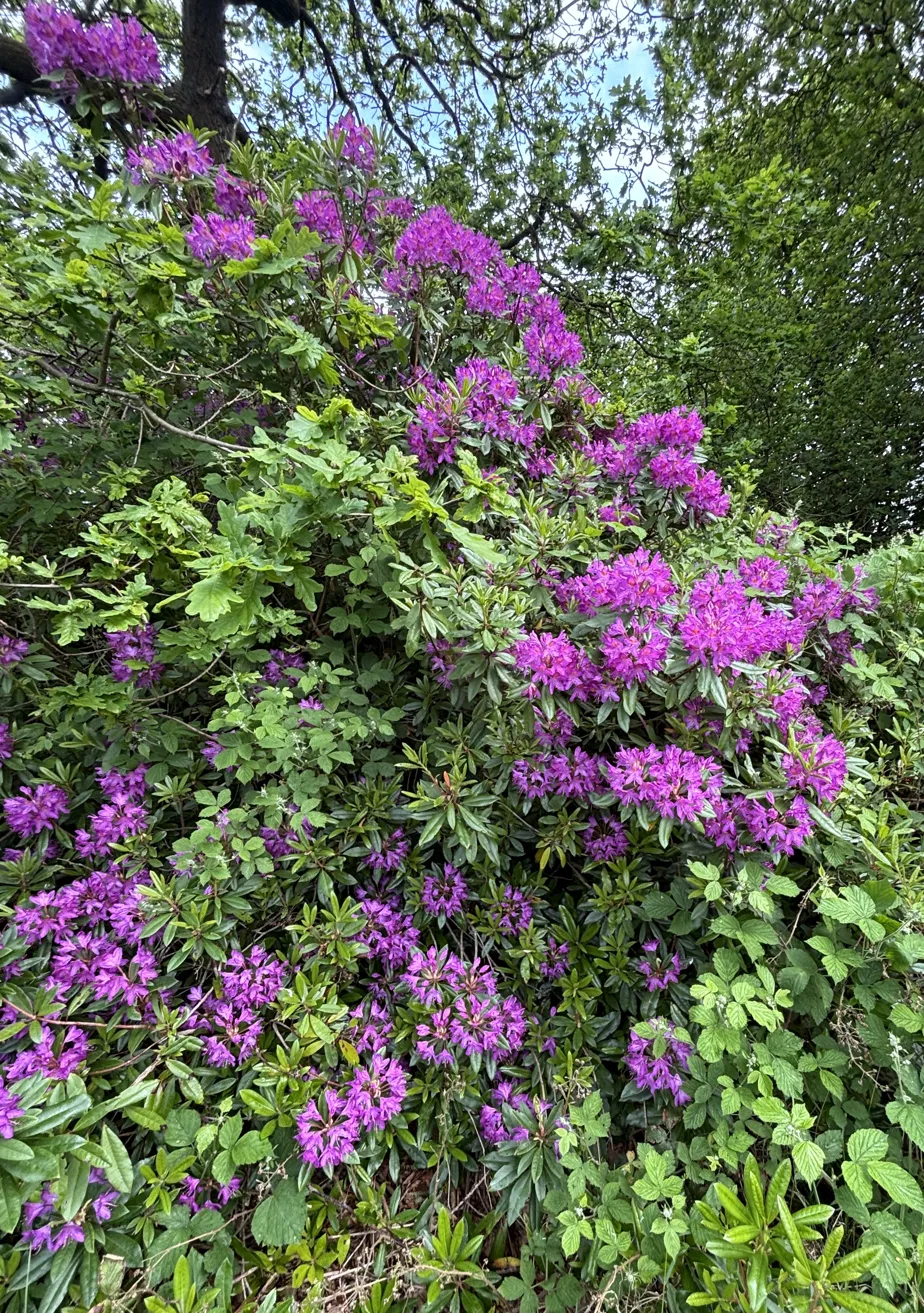
Intensity of colour that stops you mid-stride, even on a grey morning
There is a tree with a fairy door at its base — a small painted arch, rainbow-coloured, with a tiny wooden signpost alongside it. Someone placed it there carefully, and it has stayed. That makes me smile every time.
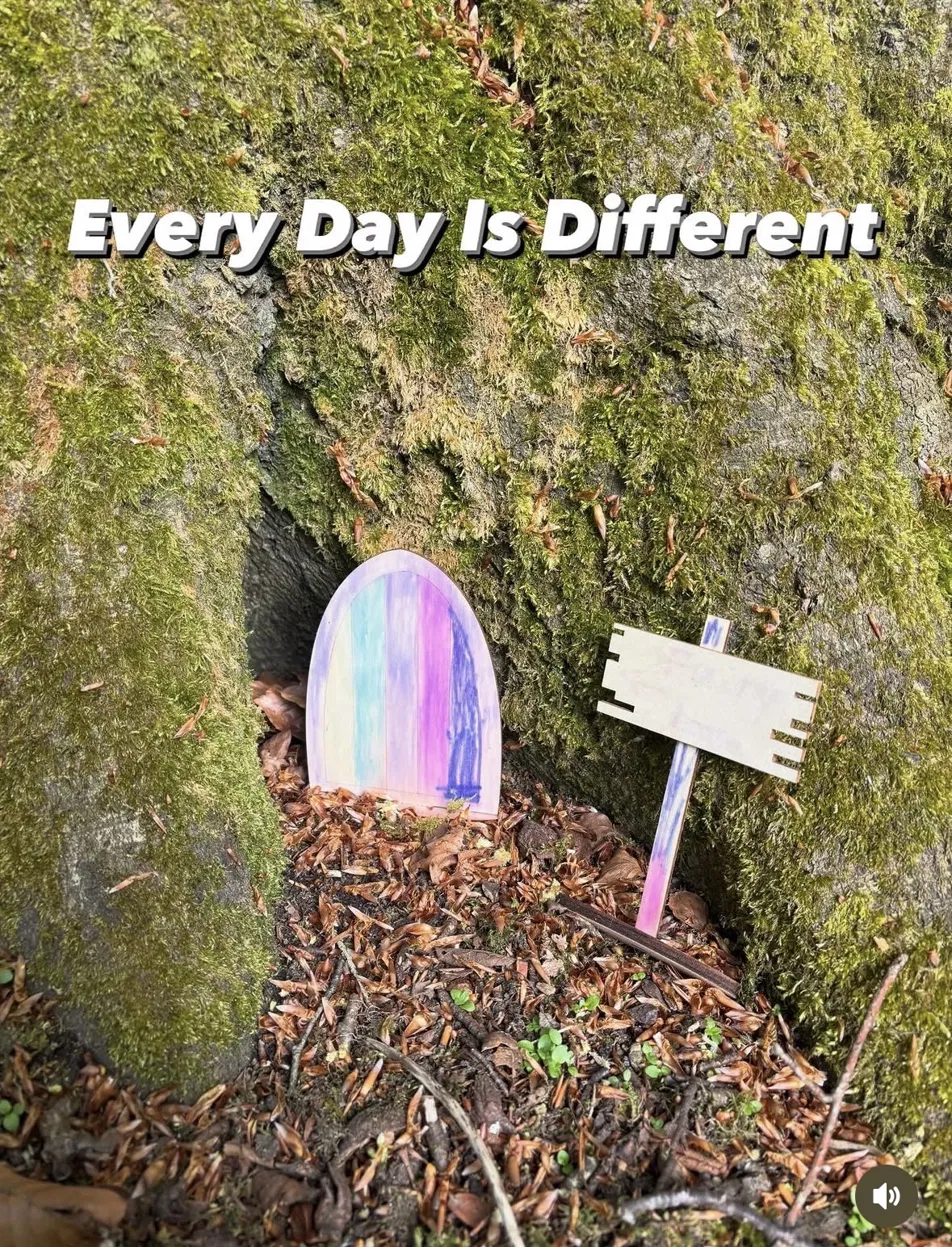
Every day is different — the caption on this Instagram post turned out to be the whole point
So does Dexter jumping a large log with his front legs and back legs independently, the way dogs do, in a movement that looks simultaneously athletic and ridiculous.
And on days when the path opens up toward the ridge, there are the Pentland Hills — the hills that Edinburgh sits at the edge of. Go a different way and you get the Bathgate Hills on the other side. On very clear days, which are rarer than you'd like in Scotland but more frequent than you'd expect, you can see across the Firth of Forth to the Kingdom of Fife, and the Forth Road Bridge, and the world-famous Rail Bridge, and the newer Queensferry Crossing. On one of those hills, on an exceptionally clear morning, I have seen the Castle from the top.
All of this, on a dog walk. Twenty minutes. Free.
Why noticing is not trivial
I want to be clear about something. I am not a natural optimist. I can moan with the best of them — about the weather, about admin, about the gap between how things should work and how they actually do. I am also aware that there is a version of the gratitude conversation that is insufferably smug — the kind that implies that poor mental health is simply a failure to notice enough sunsets. That is not what I am describing.
What I am describing is a specific neurophysiological mechanism that has been well enough studied to say with confidence: directed positive attention changes your autonomic nervous system state. And your autonomic nervous system state is the most upstream variable in your health picture — more upstream than your diet, more upstream than your supplements, more upstream than your sleep hygiene protocol. If your nervous system is running in chronic sympathetic activation — the fight-or-flight background hum that characterises modern life for most people — nothing else you do for your health works as well as it should.
The Neuroscience — What Gratitude Actually Does
Cortisol reduction
Multiple studies show that gratitude practices reduce salivary cortisol and self-reported stress. The mechanism involves prefrontal cortex activation which downregulates amygdala-driven threat response — shifting the HPA axis away from chronic activation.
HRV improvement
HeartMath Institute research shows that positive emotional states — including gratitude — produce cardiac coherence: improved heart rate variability reflecting increased vagal tone. HRV is the single most accessible proxy measure for autonomic balance.
Dopamine and serotonin
Gratitude activates the medial prefrontal cortex and anterior cingulate cortex — regions involved in reward processing. This drives dopamine release. Serotonin synthesis in the raphe nucleus is upregulated by positive social and environmental attention.
Neuroplasticity
Repeated activation of positive attentional circuits strengthens them — neurons that fire together wire together. A daily gratitude practice physically changes the neural architecture of attention over weeks to months. This is not metaphor. It is structural change.
The daily walk with Dexter is not a mindfulness practice in the formal sense. I am not counting breaths or doing a body scan. I am just walking, looking at things, and deciding that some of them are worth noticing properly. That decision — repeated daily — accumulates. Small uplifts of mood, stacked consistently over weeks, build something that begins to function like a genuine baseline shift. You do not suddenly become someone who never gets irritated by admin. You become someone whose nervous system is slightly less on edge most of the time, and for whom the irritations therefore produce a smaller spike and a faster recovery.
That is worth a great deal clinically. It is worth more than most supplements.
The cemetery walk
This past weekend was the anniversary of my mother's death. My father, as he does each year, went to put flowers at the grave. I took Dexter.
Dexter, being a dog, was delighted by the cemetery in the way that dogs are delighted by any space with interesting smells and long paths to run. He ran the lengths of the paths between the graves — not oddly, not disrespectfully, just with the particular joy of a dog given a clear straight line and permission to use it.
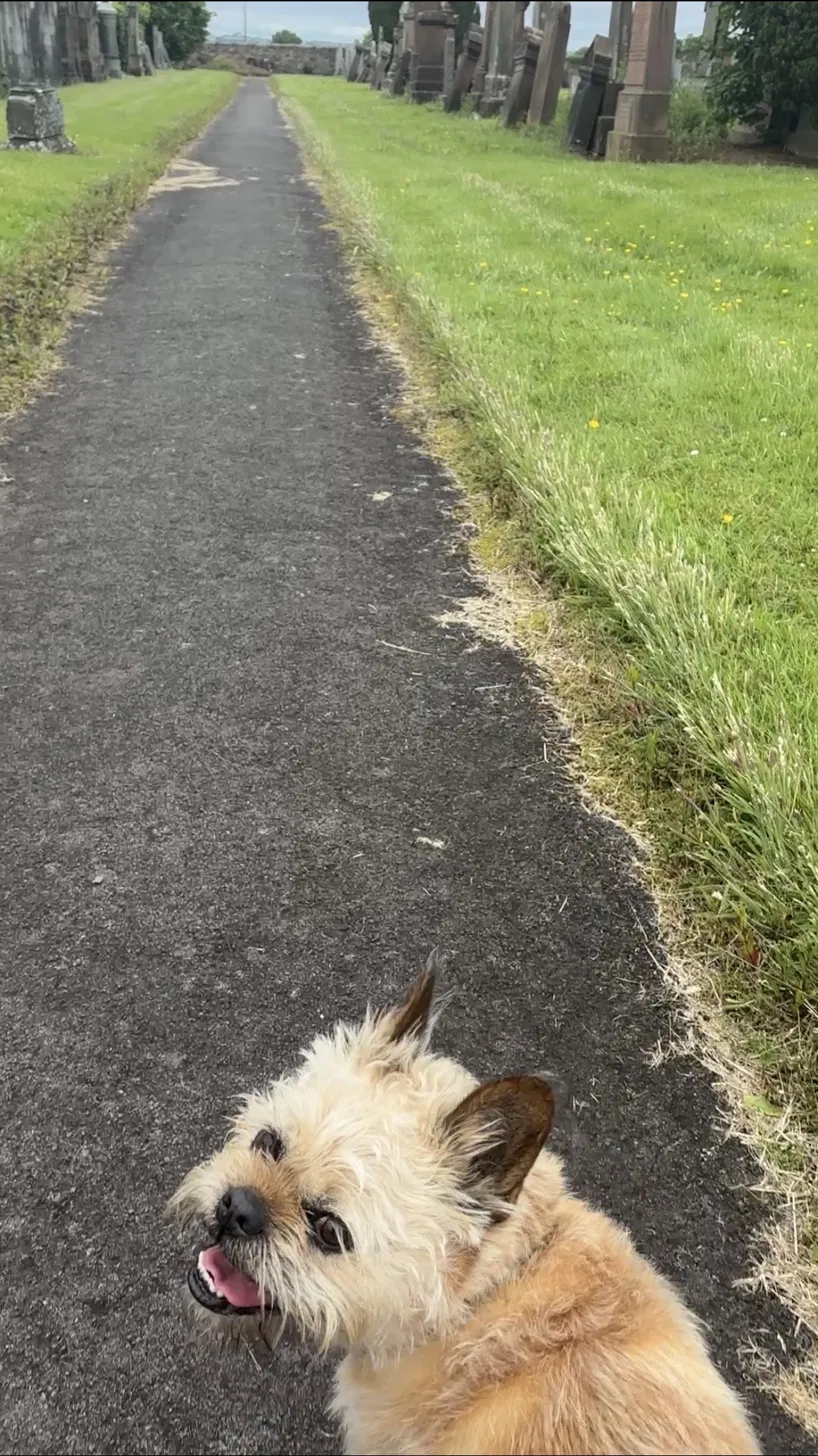
Dexter at the cemetery on the anniversary of my mother's death — entirely, uncomplicatedly present
Whatever the weather, whatever the weight of the occasion, he was entirely and uncomplicated in the moment.
There is something to be said for that. Not as a diminishment of grief — grief is appropriate, grief is correct, grief is what love looks like after loss — but as a reminder that presence and loss are not mutually exclusive. You can stand at a grave and also notice the sky. You can feel the absence of someone and also notice that the dog is happy. Both things are true simultaneously. The capacity to hold both — to be where you are, with what is there, while also carrying what is not — is perhaps what genuine psychological resilience actually looks like.
I did not learn this from a book. I learned it, in part, from a dog running between graves on a grey Scottish morning.
"Small uplifts of mood, stacked consistently over weeks, build something that begins to function like a genuine baseline shift. You do not become someone who never gets irritated. You become someone whose irritations produce a smaller spike and a faster recovery."
It does not have to be a dog
I am aware that not everyone has a dog, and not everyone wants one. The dog is my thing — the particular vehicle through which the practice happens for me. What the dog provides, structurally, is a daily non-negotiable appointment with the outside world that is explicitly not about me. That structure is the important part.
The same practice works through any daily walk undertaken with the specific intention to notice rather than process. Through a garden. Through a commute on foot. Through a park that you have walked through a hundred times without seeing. The content of what you notice is less important than the practice of noticing — the deliberate directing of attention toward what is already present rather than what is absent, unresolved, or anticipated.
It does not require good weather. The Scottish woods are more often grey and wild than clear and bright. The rhododendrons bloom regardless. The conifer is still magnificently out of scale on a November morning with the rain coming sideways. The fairy house does not disappear in winter. These things are not contingent on conditions being optimal, which is the clinical point: the practice works in suboptimal conditions because the suboptimal conditions are most of the time, and that is when the practice matters most.
A note on dandelions
Along the verge in the woods, when the season is right, there are dandelion flowers. I pick them occasionally and eat them on the walk — checking first, with the caution of someone who has learned from experience, that no dog has been by that particular patch recently.
A German client told me many years ago that dandelion is grown in fields in Germany specifically for its medicinal value. She was right. Taraxacum officinale is one of the most clinically useful plants in the hedgerow: a liver bitter that stimulates bile production and flow, a prebiotic through its inulin content, a gentle diuretic (which is exactly what the French name pissenlit describes without delicacy), and an anti-inflammatory through its luteolin and apigenin content. Dr Dietrich Klinghardt, whose work I respect particularly in the area of complex chronic illness, is an advocate. The Ki Sciences dandelion tincture is something I have used both personally and with clients — as a digestive bitter, taken in water before meals, to support bile flow and gastric acid stimulation.
One caution worth noting from personal experience: the stem sap is a different matter from the flower. If you intend to eat dandelion on a walk, eat the flower. Consume the stem sap in any quantity and you will discover, with some urgency, that it is a highly effective laxative. Nature is efficient. It is also occasionally unsubtle.
Herb of the Month · Coming Soon
Dandelion — The Field Medicine Everyone Walks Past
A full clinical profile of Taraxacum officinale — liver support, bile stimulation, prebiotic inulin, anti-inflammatory flavonoids, Klinghardt's clinical use, Ki Sciences tincture, dandelion coffee, and the honest laxative warning. Coming in the next edition of our Herb of the Month series.
The practice, in plain terms
Go outside daily. Walk for at least twenty minutes. Take a dog if you have one — it makes the non-negotiability easier to maintain. Leave your phone in your pocket. Look at things. Name, silently, three things that you notice that are worth noticing — one natural, one human-made, one small. Repeat tomorrow. That is the entire protocol. No app required. No subscription. No journal unless you want one.
The clinical return, compounded over months, is a measurable shift in autonomic baseline, reduced cortisol load, improved HRV, and the kind of mood stability that no supplement can provide as efficiently because no supplement addresses the upstream driver with the same directness.
Health does not always start in the clinic. Sometimes it starts at the top of the street, with a dog, in front of a tree that is taller than it has any right to be.
The lifestyle picture — tested, not guessed
The DUTCH Plus assessment includes cortisol pattern, HRV-adjacent markers, and the HPA axis picture that tells you where your nervous system baseline actually sits. If chronic sympathetic activation is the upstream driver of your symptom picture, no supplement addresses it as efficiently as knowing — and then targeting — the specific pattern.
Book a Strategy Call →