I found them at the weekend. Three diaries — 1994 and 1995 in blue, 1996 in black — lying side by side on a shelf where they have apparently been sitting for thirty years without me thinking much about them.

1994 · 1995 · 1996 — Three years of daily training records. The 1994 diary's worn spine tells most of the story.
The 1994 diary is the most worn. The spine is bent, the cover scuffed, pages slightly buckled at the edges in a way that suggests it was carried rather than stored. That is not incidental. These were working documents — not journals kept for posterity but operational records written at the end of each training session, sometimes at the gym, sometimes in the car, sometimes with the specific urgency of someone who had just competed and needed to get the debrief down before the details faded.
I was 24 in 1994. Training for boxing and athletics simultaneously. Working on my MSc in Coaching Studies and Applied Physiology, the academic content of which was — in that year, finally — making its way from theory into actual practice. I had done the sports science undergraduate and taken in relatively little. The Master's was different: by 1994, periodisation had stopped being a concept I understood and become something I was actually doing.
The intensity coding system
The year planner pages at the front of each diary show the full picture at a glance. Each day of the year is coded with letters representing training intensity. It is a simple system — but simplicity is not the same as superficiality.
RRest — no training
LLow — active recovery, light movement
MMedium — moderate session, controlled effort
HHigh — hard session, significant physiological load
VHVery High — maximal effort, competition simulation
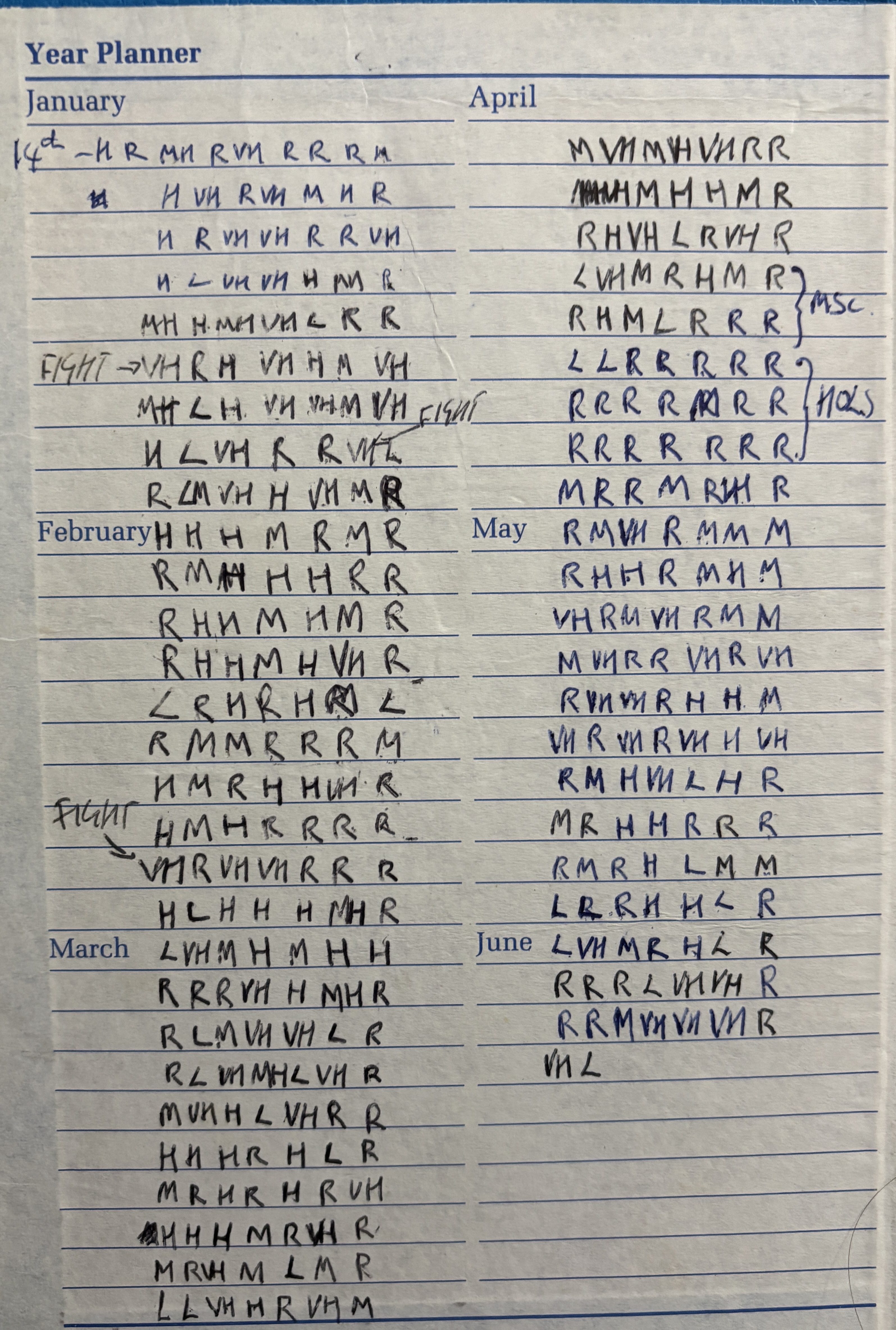
The full year at a glance. January to June — the preparation phase building toward competition. FIGHT markers visible in the January and February rows. MSc and HOS annotations in the April column.
Looking at the year planner now, the periodisation logic is visible immediately. The early months show sequences of mixed intensity building progressively — M H M R, H H M H R, VH H M R — the characteristic pattern of a preparation phase with adequate recovery built in. The fight dates are marked with arrows. The days immediately before each fight shift toward rest and low intensity. The days after each fight are also rest, which tells you that the athlete — me — understood the difference between recovery and laziness in a way that a significant proportion of gym-goers in 2026 still do not.
The MSc annotation in the April column is the academic year peaking alongside the competitive season. Both loads at once, which is either admirable commitment or poor planning depending on your perspective. Probably both.
The week-by-week record
The daily entries are where the real information lives. February 1994, Week 7 — the week leading into a fight — shows exactly what pre-competition preparation looked like in practice.

Monday to Wednesday, February 1994. Skipping, sprint intervals, punch combination drills, shadow sparring, and a Wednesday run described as: "pushed it up but really struggled."
Monday 14th: skipping, 20m sprints flat out, bursts of punches, 30-second circuits, jumping combinations, 4-punch combination days. 32 minutes total. Stretch hamstrings, shoulder rotations, "still mainly forward, feel pretty good."
Tuesday 15th: Boxing gym twice — 8pm and 6pm. Circuit training, half of normal, moderate-hard. Shadow sparring. Light opening, 3×2 minutes. Then the honest assessment, written in the same hand: "Not very hard or hard. Covered up well but didn't punch enough at cover. Fast left jabs and hooks, but not landing. Throwing enough rights. Moved round well. Best shadow spar after."
Wednesday 16th: 148lbs on the run. 6-minute warm up, gentle jog. 30-minute hard running — 10 minutes fast, 10 moderate, 10 pushed it up but really struggled. Very sore hip abductors.
What strikes me reading this thirty years later is not the training content — which by contemporary standards would be considered unremarkable — but the quality of observation. "Fast left jabs and hooks, but not landing." "Moved round well." "Really struggled." "Sore hip abductors." These are not vague self-assessments. They are clinically precise observations of specific movement quality, physiological response, and technical execution. Made on a Tuesday evening in a gym, written in biro, with no prompt from any device.
Fight day
Thursday and Friday of that week: boxing circuit, weight tracking (67.5kg, then 66.5kg), rest with hamstring stiffness noted. Saturday: another rest day, still stiff, helps to stretch. Weight 66.1kg. Then Sunday 20th February.
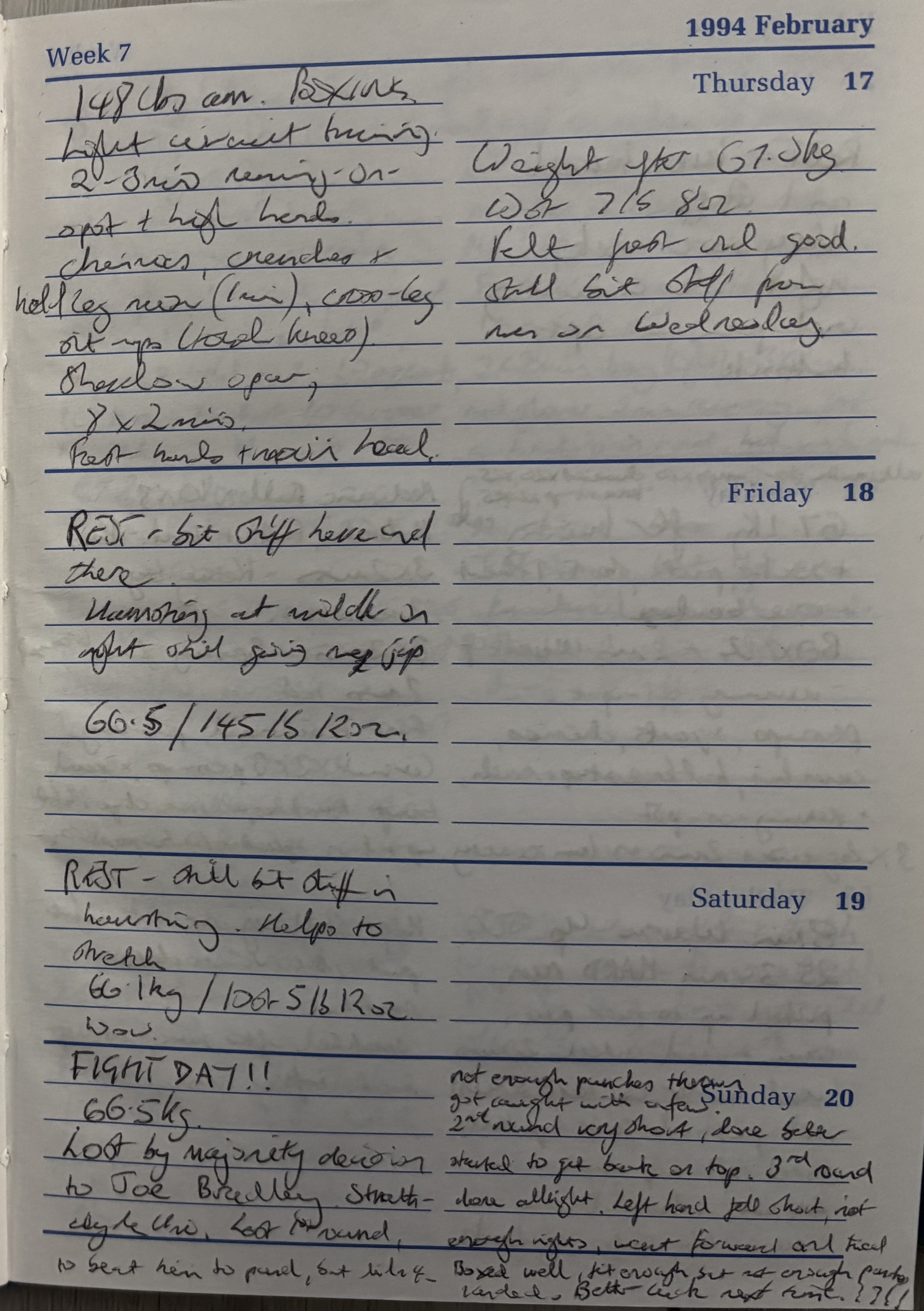
Thursday 17th through Sunday 20th February 1994. Weight management, rest days, hamstring stiffness — then FIGHT DAY. The post-match analysis fills the right-hand column.
Sunday 20th February 1994 · Fight Day · 66.5kg
Lost by majority decision to Joe Barcelley, Strathclyde Uni. Lost 1st round, to beat him to punch but felt — not enough punches thrown, got caught with a few. 2nd round very short, done better, started to get back on top. 3rd round done alright. Left hand jabs short, not enough rights, went forward and tried. Boxed well, fit enough, not enough punches landed. Better luck next time.
There is an entire coaching philosophy in that paragraph. The athlete lost. The athlete immediately identified the specific technical deficits — not enough punches thrown, left jabs short, not enough rights — rather than attributing the outcome to the opponent, the judges, or bad luck. The athlete also identified what worked — moved well, fit enough, got back on top in the second — without letting the positive obscure the technical lessons. And then, in four words that contain everything you need to know about psychological resilience in competitive sport: better luck next time.
Not a promise to train harder. Not a catastrophising spiral. An honest appraisal, a clear diagnosis of what needs to change, and a composed closure that leaves space to begin again.
I remember that fight. He was throwing more right hands than I expected — it disrupted the game plan. I hurt him in the third but it was too little too late. Three rounds of two minutes each in amateur boxing is a sprint from the first bell. You do not have time to find your rhythm. You have to hit the ground running, and I didn't get going in the first. Not enough sparring in the build-up — I was fit but not sharp. That lack of sharpness was in my head before the first bell, which is the most expensive kind of under-preparation there is.
The annual plan — sports science on paper
In among the training materials from this period is a document that is worth more than all the diary entries combined as a demonstration of applied sports science. A hand-drawn annual periodisation plan for the 1993-94 season. Type: monocycle. Coach: Stevie Duncan. Athlete: Stephen Duncan.
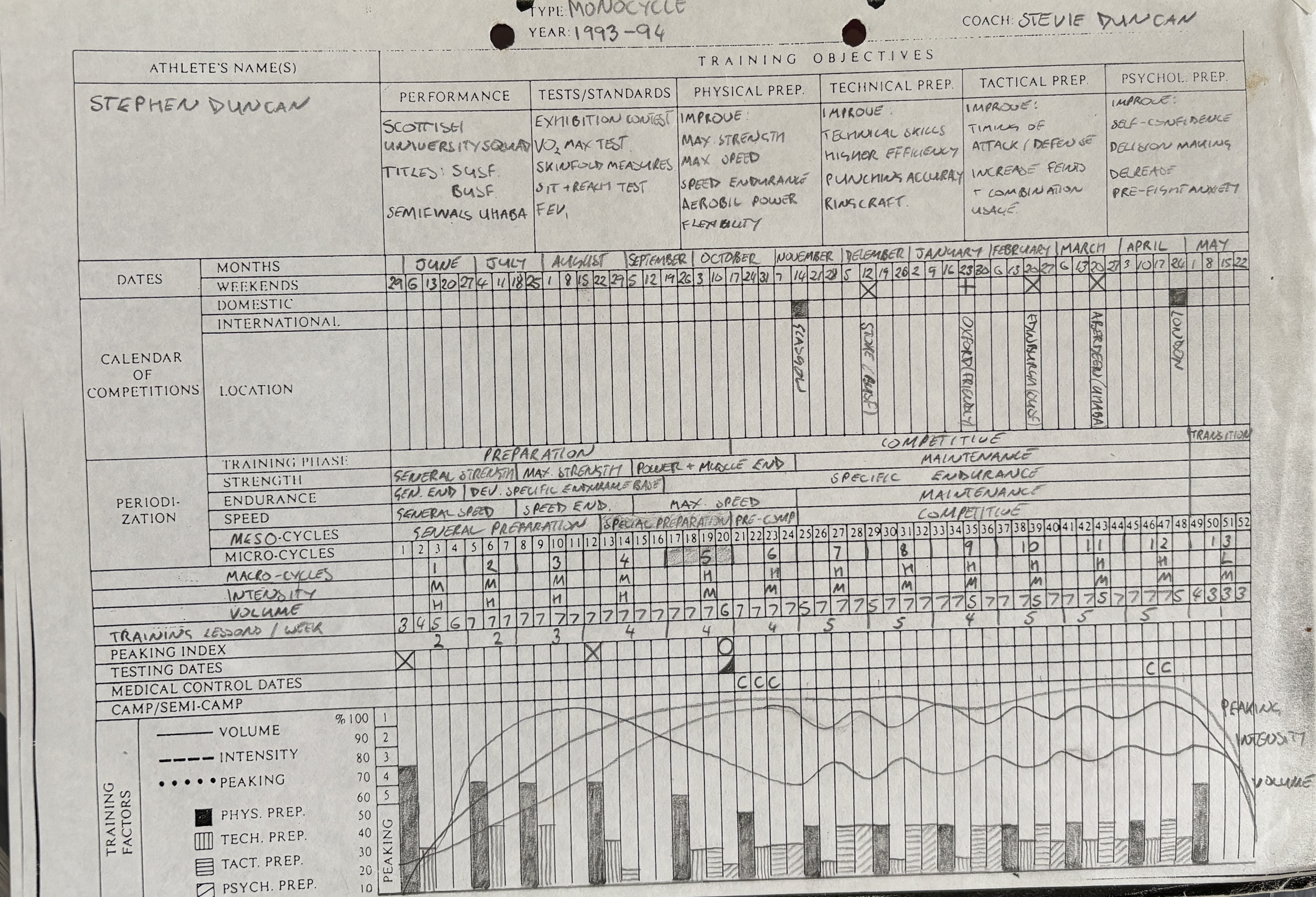
Annual periodisation plan, 1993–94. Hand-drawn in pencil. Preparation → competitive → transition phases. Volume/intensity wave forms at the bottom. Training objectives across six columns: performance, physical, technical, tactical, psychological. Coach: Stevie Duncan. Athlete: Stephen Duncan.
The plan covers the full competitive year from June to May. Training objectives are broken across six columns: performance targets (Scottish University Squad, SUSF titles, BUSF, UHABA semifinals), tests and standards (VO2 max, skinfold, sit-and-reach, FEV), physical preparation (max strength, max speed, speed endurance, aerobic power, flexibility), technical preparation (technical skills, higher efficiency, punching accuracy, ringcraft), tactical preparation (timing of attack and defence, increasing feints, combination usage), and — notably — psychological preparation: self-confidence, decision making, decreasing pre-fight anxiety.
The periodisation structure shows preparation, competitive, and transition phases. Macro-cycles, meso-cycles, micro-cycles. Training volume and intensity drawn as wave forms — the characteristic inverted relationship where volume decreases as intensity increases approaching competition, the taper before the peak. All of this produced on paper with a pencil, without software, without GPS, without any device at all. Just the knowledge, applied.
The coach and athlete being the same person is worth noting. I was planning my own training year, implementing it, competing in it, and retrospectively evaluating it — simultaneously. That dual perspective of coach and athlete is one of the most valuable things an athlete can develop, and one of the rarest. Most athletes experience their training subjectively. Most coaches observe it objectively. The ability to do both at once — to feel what is happening and also analyse what it means — is the closest thing to a superpower in sport.
"Most athletes experience their training subjectively. Most coaches observe it objectively. The ability to do both at once — to feel what is happening and also analyse what it means — is the closest thing to a superpower in sport."
What wearables do — and what they don't
In 2026, almost every serious athlete owns a wearable device. Heart rate monitors, GPS watches, HRV trackers, sleep quality scores, training load metrics, recovery readiness indices. The data generated by a week of Garmin or Whoop data would fill a spreadsheet that would take an hour to read.
Most athletes do not read it. Or they read the headline number — "recovery score 62, take it easy today" — without ever asking the questions that the 1994 diary was built around: Why is it 62? Which session from the last three days produced that number? Was it the volume, the intensity, or the sleep? What specifically needs to change in today's session to address the deficit without losing the fitness adaptation?
The diary forced a different kind of engagement. Writing "very sore hip abductors" is not the same as reading a muscle strain alert on an app. It is an act of deliberate observation that produces a qualitatively different level of awareness. The athlete who writes "didn't punch enough at cover" after a sparring session has done something that no wearable can do: they have translated a felt experience into a specific, actionable technical observation.
I spent a period in the 1994 era playing what I would now call heart rate games. How high can you get it? How long can you keep it there? Maximum effort on the treadmill, rowing machine, barbell squat. Legs buckling and keep going. Heaviest bag available, hell for leather until lights out. This is not a training methodology I would recommend. But it taught me something that twenty years of working with athletes has confirmed: the most reliable training metric available is the athlete's own honest assessment of how they feel, what they did, and what happened as a result. Every device since has been a supplement to that, not a replacement for it.
What the Diary Did That the Device Doesn't
Qualitative observation
"Fast jabs but not landing" tells you something about technical execution under fatigue. No sensor measures this. Only the athlete who notices it and writes it down captures it.
Honest post-competition analysis
A post-match debrief written in the athlete's own hand, identifying specific deficits without excuses, is more valuable than any performance metric. It creates accountability to the self.
Weight management context
Daily weight tracking alongside training load and fight date gave a complete picture of the body's response to stress. The device tracks weight. The diary tracks what was happening simultaneously.
The planning-execution feedback loop
The annual periodisation plan and the daily diary created a closed loop: plan → execute → observe → adjust → plan again. This loop is the heart of athletic development. Wearables provide data for one step of it.
The clinical parallel
The reason I am writing about a thirty-year-old boxing diary in a clinical health context is that the discipline it represents — systematic self-observation, honest appraisal, planning that integrates multiple variables simultaneously — is exactly what distinguishes clients who get genuine health outcomes from those who remain stuck.
The athlete who records training sessions, notices patterns, makes adjustments, and evaluates their own performance honestly is doing the same cognitive work as the client who tracks symptoms, notices triggers, makes dietary and lifestyle changes, and evaluates their own functional picture honestly. The mechanism is identical. The domain is different.
Testing gives you the objective data — the equivalent of the VO2 max test and skinfold measurements in the periodisation plan. The subjective observation — the diary, the daily check-in, the honest acknowledgement that you are sore or tired or not moving as well as last week — gives you the context that makes the objective data meaningful. Neither is sufficient without the other.
The three diaries on the shelf are thirty years old. The principle they represent is not.
Test what's actually limiting your performance
The athlete performance testing framework at Detective Health gives you the objective data layer — the functional tests that reveal stress hormones, anabolic capacity, mitochondrial function, neurotransmitter balance, and nutrient status. Combined with the kind of honest self-monitoring these diaries represent, it tells you not just what is happening but what to do about it.
View the Athlete Testing Page →