My Italian grandparents did not have a wellness strategy. They did not track their macros, attend a breathwork class, or take an adaptogen before bed. What they had was a way of living that, viewed through the lens of nearly forty years of working with people and the full body of functional medicine research, looks remarkably like what I now spend my professional life trying to help people rebuild.
They ran a restaurant in Ayr on the west coast of Scotland — the kind of place where the food was made from real ingredients, where meals were a serious daily ritual rather than a refuelling stop, and where the view across the water to the Isle of Arran and Ailsa Craig reminded you, if you needed reminding, that you were a relatively small thing in a very large world.
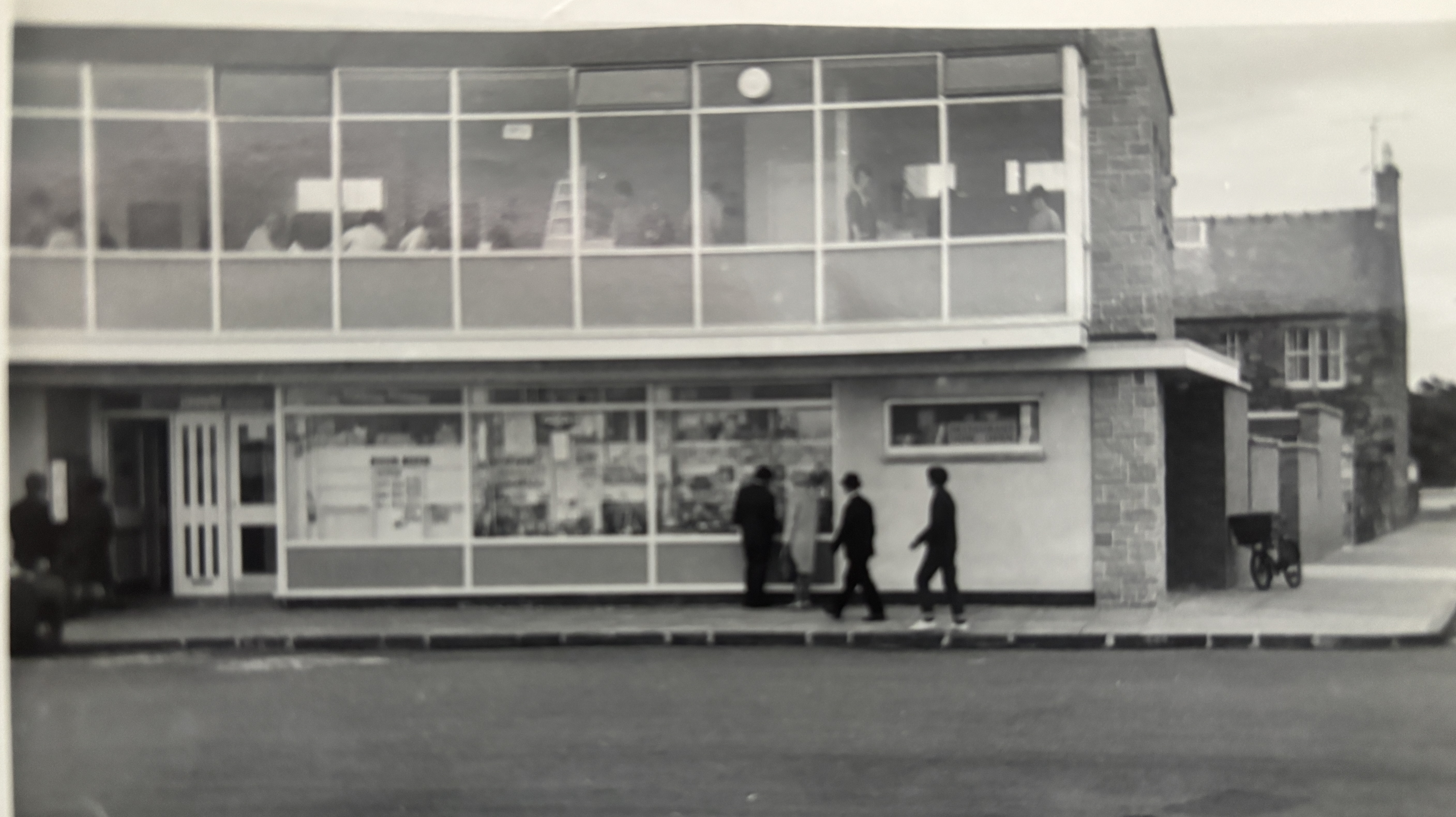
The building, Ayr, late 1960s. The upper glazed floor is the restaurant — you can see diners through the windows. The ground floor housed the post office (where my mother worked) and an ice cream and seaside shop, entirely typical of the Scottish coast in that era. Above the restaurant, invisible from this angle, was a rooftop terrace with an uninterrupted view across the water to Ailsa Craig — "Paddy's Milestone" — and the Isle of Arran. Alfresco dining on the west coast of Scotland in the 1960s. My grandfather built it anyway.
That photograph is doing a lot of work. There's the restaurant itself — modernist, confident, with that extraordinary glazed upper floor that functioned as a rooftop dining room overlooking the sea. An alfresco dining experience in Scotland in the 1960s was genuinely unheard of. My grandparents built it anyway, because that is how Italians think about food and the experience of eating it. The post office to the right of the building is where my mother worked. My father walked past one day, noticed her, and found a reason to go in. Their first date was at the postmaster's ball. The restaurant was not just where my grandparents fed people — it was, in the most literal sense, where my family began.
My Scottish-Italian background is not incidental to who I am as a practitioner. It is foundational to it. This post is about what my grandparents knew — not academically, but experientially, intuitively, generationally. And it is about why the research I've spent decades studying has done nothing but confirm what I watched them live.
The Mediterranean Lifestyle Is Not a Diet
Here is the thing that gets lost every time the Mediterranean diet appears in a newspaper headline: it was never primarily about the food. The PREDIMED trial — one of the most important nutritional studies of the last 20 years, which demonstrated significant cardiovascular risk reduction in those following a Mediterranean dietary pattern — was studying a food culture, not a macronutrient ratio. The food existed within a way of living that included regular physical activity, long meals with social engagement, structured rest, and an orientation towards pleasure rather than anxiety around eating.
Extract the olive oil and put it in a capsule, and you get some of the benefit. Keep the olive oil in the meal, eat the meal slowly with people you love, follow it with a walk, and rest properly that afternoon — and you get considerably more. The mechanism is not additive. It's synergistic. That's not a marketing phrase. It's what the data shows when you study the whole pattern rather than individual components.
What the Research Actually Shows
PREDIMED Trial (Estruch et al., 2018, NEJM): 7,447 participants at cardiovascular risk randomised to Mediterranean diet supplemented with olive oil, Mediterranean diet supplemented with nuts, or a low-fat control diet. Mediterranean diet groups showed 30% relative risk reduction in major cardiovascular events. The olive oil arm showed the strongest effect on stroke reduction specifically.
Longevity research — the Blue Zones (Buettner, National Geographic / PNAS): Five geographic zones of exceptional human longevity (Sardinia, Okinawa, Nicoya, Icaria, Loma Linda) share seven common features: movement woven into daily life, sense of purpose, stress-reduction practices, moderate caloric intake, plant-predominant diets, belonging to faith or community, and strong social networks. None of the five lists "optimal supplement protocol" as a shared feature. All five list community and purpose.
Social connection as a mortality predictor: A 2015 meta-analysis by Holt-Lunstad et al. in Perspectives on Psychological Science, analysing 148 studies covering 308,849 individuals, found that adequate social relationships were associated with a 50% increased likelihood of survival. The effect size was comparable to quitting smoking and exceeded that of physical activity and obesity. This is not soft data. It is as hard as outcomes data gets.
The Table as Clinical Intervention
My grandparents ate together. Every meal. The table was not a convenience — it was a commitment. Meals were long, deliberately so. The food was prepared with attention to what it was and where it came from. Nothing was eaten standing at a counter. Nothing was eaten in front of a screen. The meal was the event.
I now understand what this was doing physiologically. Eating slowly in a relaxed social environment keeps the nervous system in parasympathetic dominance — the state in which digestion works properly, gastric acid is secreted at the right time, digestive enzymes are released, gut motility proceeds smoothly. The cephalic phase of digestion — triggered by the sight, smell, and anticipation of food — requires a certain quality of attention that you cannot generate while simultaneously scrolling or working or driving. My grandparents, without knowing anything about the vagus nerve, were optimising its function at every meal.
The social element matters separately and importantly. Oxytocin — released through genuine social connection — directly modulates the HPA axis, reducing cortisol and shifting the autonomic balance toward parasympathetic. Eating with people you trust and enjoy is not just pleasant. It measurably changes the hormonal environment in which digestion occurs.
"The Italian word for this — convivialità — translates roughly as conviviality, but the root is con vivere: to live together. They understood that eating was something you did with people, not something you did to yourself."
Movement as a Daily Fact, Not a Scheduled Event
My grandparents walked. Not as exercise — as a way of being in the world. The restaurant required movement. The shopping required movement. The social life of an Italian family on the west coast of Scotland required walking between people's houses, between the market and the kitchen, between the kitchen and the dining room. Movement was not something you carved 45 minutes out of your day to do. It was the texture of the day itself.
This maps directly onto what the exercise science research tells us about the difference between structured exercise and non-exercise activity thermogenesis (NEAT). People in traditional cultures with low rates of chronic disease are not doing more gym sessions than Westerners. They are doing more total movement — walking, carrying, gardening, cleaning, cooking — throughout the day. This continuous low-level muscular activity maintains insulin sensitivity, supports gut motility, regulates cortisol, and keeps the lymphatic system moving in a way that three sessions of intense training per week, surrounded by eighteen hours of sitting, does not replicate.
The post-meal walk — the passeggiata — is one of the most evidence-backed interventions in metabolic medicine. Ten to fifteen minutes of gentle walking after meals reduces the post-meal glucose spike measurably, by pulling glucose into working muscle without requiring insulin. My grandparents did this not because they had read a paper in Sports Medicine on post-prandial glycaemic control. They did it because it felt right, and because everyone they knew did it, and because it was part of what eating meant.
Rest Was Not Laziness. It Was Structure.
The Italian relationship with rest is something the northern European Protestant work ethic has never quite understood. The afternoon rest is not laziness. It is a physiological reset built into the architecture of the day — a deliberate parasympathetic window in the middle of the cortisol curve, timed to the post-lunch dip in alertness that is not cultural but biological. The siesta exists across multiple Mediterranean cultures not because those cultures are less ambitious but because they were paying attention to what their bodies were telling them.
Cortisol follows a diurnal pattern — highest in the morning (the cortisol awakening response that gets you mobile), declining through the afternoon, lowest in the evening. A brief rest in the early afternoon — not a long sleep, 20 to 30 minutes is optimal — aligns with the natural trough in this curve and allows the HPA axis a recovery window before the evening. The evidence for the cardiovascular benefits of regular napping in populations that practise it is meaningful: a 2019 study published in Heart found that occasional napping was associated with significantly lower risk of fatal and non-fatal cardiovascular events compared to non-nappers, after controlling for confounders.
The Food Itself — And Why Provenance Matters
My grandparents cooked from ingredients, not from packets. The olive oil was real olive oil — cold-pressed, deeply green, peppery, the kind that makes you cough slightly if you take a spoonful because the oleocanthal content is high enough to inhibit the same COX enzymes that ibuprofen targets. The vegetables were fresh, seasonal, often from someone's garden. The bread was made properly, with time. The tomatoes tasted like tomatoes.
This is not nostalgia. The difference between extra virgin olive oil and a cheap "olive oil blend" is not merely culinary — it is clinical. High-polyphenol EVOO has measurable anti-inflammatory effects, measurable gut microbiome benefits (specifically supporting Akkermansia and Bifidobacterium), and measurable endothelial function improvements in human trials. The polyphenol content of genuine cold-pressed EVOO from a good harvest is often ten times higher than the refined oils that dominate supermarket shelves. The freshness matters. The provenance matters. What the tree grew in matters.
I'm looking forward to featuring a single-estate Italian olive oil on this site in the not-too-distant future — from an olive grove whose quality I can personally speak to. When that happens, I'll write the full post. In the meantime, if you want to understand what I mean about provenance: buy one bottle of genuine cold-pressed, high-polyphenol EVOO from a trusted small producer and taste it next to what you usually buy. The difference is unambiguous.
What This Has to Do With Test, Don't Guess
Here is where I want to be honest about the tension I hold, because I think it matters.
The lifestyle I've just described — the shared meals, the daily movement, the proper rest, the real food, the social connection — is genuinely powerful medicine. The evidence base for each of those elements is solid. For a significant number of people, implementing them consistently would produce meaningful improvements in energy, metabolic health, gut function, mood, and longevity. I believe this completely.
And yet I also know — from nearly forty years of working with people — that there are people for whom the lifestyle work is not enough. Not because they're not committed or not doing it correctly. Because there is something underneath that the lifestyle work cannot fix: an H. pylori infection impairing gastric acid production. A thyroid conversion problem where T4 is not becoming T3. A DUTCH panel showing oestrogen clearance is impaired regardless of how well someone eats. A gut microbiome so disrupted that no amount of olive oil and Mediterranean mealtimes will reconstruct it without targeted intervention.
My grandparents would not have needed a GI-MAP test. Their gut ecology was intact because they had never been on multiple rounds of antibiotics, had never eaten industrially processed food for thirty years, had never lived in a state of chronic psychological stress disconnected from nature and community. They started from a different baseline than most of my clients do.
"The Mediterranean lifestyle is the foundation I wish everyone started from. The testing is for when the foundation has been damaged — and you need to know exactly what's broken before you can fix it properly."
This is not an either/or. The lifestyle principles my grandparents lived by are not in conflict with precision functional testing. They are the context within which that testing makes sense. You test to find what's broken. You fix what's broken. And then you support the repair with the same things that kept people healthy before the modern world made it complicated: real food, rest, movement, and the people you love around the table.
The Seven Things My Grandparents Did — That We Now Have Clinical Evidence For
- Ate real food, prepared from ingredients. High polyphenol content, intact fibre matrix, no ultra-processing. Directly supports gut microbiome diversity, GLP-1 secretion, and liver detoxification capacity.
- Ate slowly, at a table, with other people. Parasympathetic dominance during digestion, cephalic phase activation, oxytocin-mediated cortisol reduction. Measurable improvements in gastric acid, enzyme secretion, and gut motility.
- Walked after meals. Post-prandial blood glucose reduction, gut motility support, lymphatic drainage. Ten minutes is clinically meaningful.
- Used olive oil generously. High-polyphenol EVOO: COX inhibition, endothelial function, gut microbiome support, cardiovascular protection. Dose matters — four tablespoons daily is the therapeutic level in the PREDIMED data.
- Rested in the afternoon. HPA axis recovery window aligned with natural cortisol trough. Cardiovascular benefit documented in multiple prospective studies.
- Maintained strong social networks. Social connection as independent mortality predictor comparable to smoking cessation in effect size. Oxytocin, HRV, vagal tone — all measurably improved by genuine social engagement.
- Ate seasonally and with attention to provenance. Seasonal eating naturally cycles the polyphenol inputs to the gut microbiome. Attention to where food comes from — the pleasure of knowing your food — is part of the parasympathetic eating context that makes digestion work properly.
What I Carry Forward
I grew up between two cultures — Italian and Scottish — and in some ways my clinical practice sits at that intersection. The Italian side gave me an understanding of food as relationship, rest as structure, and community as medicine. The Scottish side gave me a certain directness, a preference for evidence over sentiment, and a healthy scepticism of anything that sounds too good to be true.
Test, Don't Guess is the Scottish part of me. The Mediterranean lifestyle content on this site — the recovery post, the non-negotiables, the recipes, the morning constitutional — is the Italian part. Both are necessary. Neither is sufficient without the other.
If my grandparents were alive today and I could run their labs, I'd probably find very little to fix. But I'd still take them out for a long walk, a good meal, and a glass of biodynamic wine afterwards. Some things are medicine regardless of what the numbers say.
Stephen Duncan FDN-P MSc. References: Estruch R et al. (2018 revised), NEJM — PREDIMED trial Mediterranean diet and cardiovascular outcomes; Holt-Lunstad J et al. (2015), Perspectives on Psychological Science — social relationships and mortality meta-analysis; Buettner D & Skemp S (2016), American Journal of Lifestyle Medicine — Blue Zones characteristics; Naska A et al. (2007), Archives of Internal Medicine — siesta and cardiovascular mortality; Buffey AJ et al. (2022), Sports Medicine — post-meal walking and glucose; Crous-Bou M et al. (2014), BMJ — Mediterranean diet and telomere length (biological ageing marker); Zamora-Ros R et al. (2013), European Journal of Clinical Nutrition — olive oil polyphenols and gut microbiome.