There’s a mobile hanging above a cot. Wooden birds on threads, balanced on crossbars, the whole thing turning slowly in the draught from the window.
Reach up and pull one bird down an inch.
Every other bird moves. Not because you touched them — because the whole structure was in balance, and you changed one term in the equation. The one you pulled goes down. Its opposite number swings up. The crossbar above tilts, which shifts the two beneath it, and by the time everything settles nothing is where it was.
That is minerals. And it’s why the phrase “I’m low in zinc” is almost never a complete sentence.
The Wheel
If you’ve spent time around nutritional testing, you’ve seen the diagram. A circle of mineral symbols with arrows between them — some arrows meaning this one helps that one, others meaning this one blocks that one. It’s usually called the mineral wheel, or the mineral interaction wheel.
Its origins aren’t in human nutrition at all. It comes out of soil science, from work at the University of Missouri in the mid-twentieth century, where agronomists were trying to understand why adding one fertiliser to a field could produce a deficiency of something else entirely. Add too much potassium and the crop goes short of magnesium — not because the magnesium left the soil, but because the plant can no longer take it up.
The insight transferred to human biochemistry, and various people have redrawn the wheel since, each with their own emphasis.
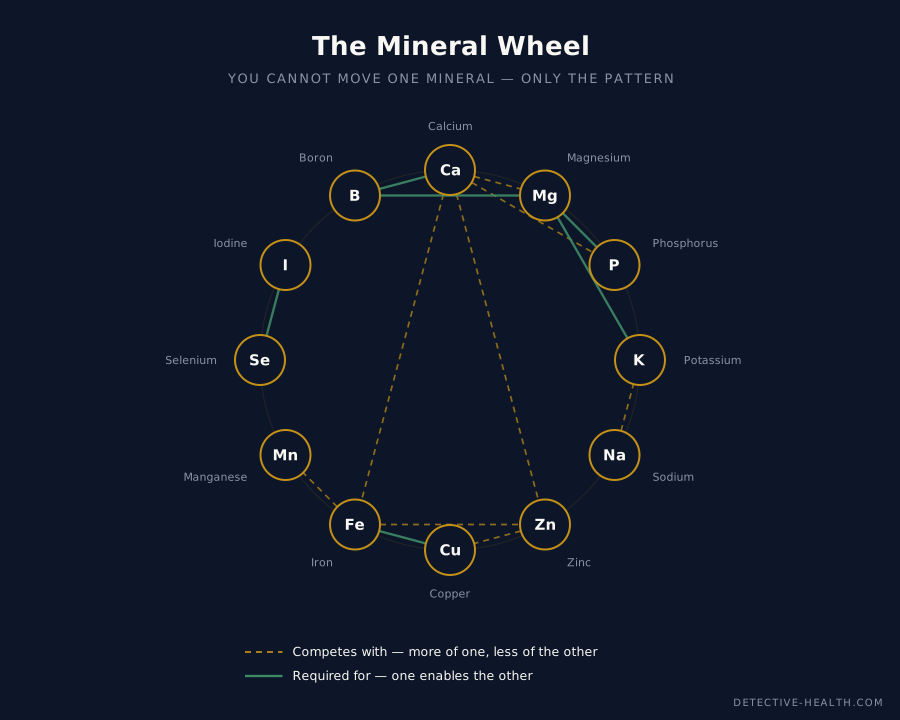
It is a heuristic — a map of relationships that clinicians have observed and that a good deal of biochemistry supports.
It is not a quantitative model. It won’t tell you that 30mg of zinc produces exactly this much copper depletion in this person. Some arrows on some versions are much better evidenced than others, and different renderings disagree with each other in places.
Treat it as a way of thinking, not a lookup table. Used that way, it’s one of the most clinically useful pictures in nutrition.
Antagonism: The Crowded Doorway
Two minerals are antagonists when more of one means less of the other.
The commonest mechanism is unglamorous: they compete for the same transporter. The gut wall isn’t an open door — it’s a set of specific gates, and several minerals share one. Divalent metal transporter 1 handles iron, but it also carries manganese, zinc, copper, cobalt and cadmium. They’re all queuing for the same doorway.
Flood the queue with one, and the others wait outside.
This is why iron supplementation can reduce zinc absorption, and why high-dose zinc reliably depletes copper — the latter well enough established that copper is routinely added to long-term zinc protocols in clinical practice, and zinc-induced copper deficiency is a recognised cause of anaemia and neurological problems in people who’ve been supplementing enthusiastically for years without knowing.
But competition isn’t the only mechanism. Some antagonism happens downstream — one mineral displacing another from an enzyme, or driving its excretion. Calcium and magnesium compete both at absorption and at the cellular level, where they act as functional opposites: calcium signals contraction, magnesium permits relaxation. Sodium and potassium sit either side of the cell membrane in a relationship the body spends a substantial share of its resting energy maintaining.
And then there are the antagonisms that work in your favour. Zinc opposes cadmium. Selenium binds mercury. Calcium and iron both compete with lead. These aren’t nuisances — they’re part of why mineral sufficiency is protective against metal burden, and part of why a depleted person is a more vulnerable person.
Synergism: The Ones That Travel Together
The arrows pointing the other way are just as important and get discussed far less.
Magnesium is required for the enzyme that converts vitamin D into its active form. So a person with poor magnesium status can supplement vitamin D through the winter, retest, and find their levels have barely moved — and conclude the vitamin D isn’t working, when the actual problem is a cofactor two steps upstream.
Copper is required for the enzymes that load iron into transferrin. Which means a person can be iron-deficient in the presence of adequate iron, because the copper needed to mobilise it isn’t there. Give them more iron and you may make things worse, because you’ve now added to the queue at the doorway that copper also uses.
Zinc, magnesium and boron all participate in the same hormonal pathways. Selenium and iodine are inseparable in thyroid function — the deiodinase enzymes that convert T4 to T3 are selenium-dependent, so iodine without selenium is a half-finished job, and in some circumstances an actively unhelpful one.
What This Means When You Supplement
Here’s the practical consequence, and it’s the whole point of the article.
You cannot move one mineral. You can only move the pattern.
Every time someone takes a single mineral in isolation at a meaningful dose, they are not adding one thing. They are pulling one bird on the mobile. The intended effect happens, and so do three or four unintended ones, and nobody’s measuring those.
The person taking high-dose zinc for their immune system, every day for two years, is running a slow copper depletion. The person taking calcium for their bones without attention to magnesium is shifting a ratio that governs vascular calcification as much as bone density. The person taking iron because a doctor said “you’re a bit low” is competing with copper, manganese and zinc at every dose.
None of them is doing anything unreasonable. Each is following advice that would be perfectly sound if minerals worked independently.
They don’t.
Why “Deficiency” Is the Wrong Frame
Which brings me back to where I started.
The deficiency model comes from a real and important era of nutritional science — the one that identified scurvy, beriberi, pellagra, rickets. One nutrient missing, one disease, one cure. It was a triumph, and it shaped how everybody still talks about nutrition a century later.
But those were single-nutrient diseases in populations with catastrophic single-nutrient absences. That is not what walks into my clinic. What walks in is someone whose whole mineral pattern has drifted — through soil depletion, food processing, chronic stress burning through magnesium, filtered water, gut inflammation limiting absorption, a decade of medication, and often several years of well-intentioned supplementation that has pulled the mobile in three directions at once.
They don’t have a zinc deficiency. They have a mineral pattern. And the ratios in that pattern tell you more than any individual number in it.
- Is this mineral low?
- Is it inside the reference range?
- What do I add to fix it?
- One nutrient, one problem, one supplement
- Calcium to magnesium
- Sodium to potassium
- Zinc to copper
- Iron to copper
- Calcium to phosphorus
A person can have every individual mineral sitting comfortably inside its reference range and still have a pattern that explains exactly why they feel the way they do.
And it’s why I won’t guess at this. If you’re going to make a change that moves the whole structure, you want to know what the structure currently looks like — not because testing is magic, but because pulling threads in the dark is how people end up worse than when they started, having done nothing but follow good advice.
What to Take From This
Three things, and they’re simple enough.
Single minerals at high dose are an intervention, not a supplement. Treat them with the seriousness you’d give a medication — with a reason, a duration and a plan to reassess. Not indefinitely, because a bottle is on the shelf.
When something isn’t working, look upstream. Vitamin D not shifting? Check magnesium. Iron not shifting? Check copper. Thyroid conversion sluggish? Check selenium. The missing piece is frequently a cofactor rather than the thing you’re measuring.
Ratios beat levels. Any individual mineral number is a snapshot of one bird on a moving mobile. The relationships between them tell you what the structure is actually doing.
Next in this series: boron — a mineral with no recommended intake, no named deficiency disease, and a surprisingly good evidence base for doing several things that matter. It’s the clearest illustration I know of how much we still don’t know about the wheel we’ve been drawing for seventy years.
Mineral status is assessed differently depending on what you need to know. Serum tells you what is circulating now and is tightly regulated, which is exactly why serum calcium looks normal in people with poor calcium status. Red cell and whole blood measures reflect longer-term status for magnesium and zinc. Hair tissue mineral analysis gives a longer window and, importantly, shows the ratios between minerals rather than isolated values. The blood chemistry panel in the TDG Five-Test Programme covers the blood-borne picture; where the question is specifically about mineral patterning and toxic metal burden, HTMA answers it better.
Which minerals are actually moving?
Before adding anything at dose, it is worth knowing what the current pattern looks like. Ask AIdan which testing fits your situation, or start with a free 20-minute call.
Ask AIdan → Book a free 20-minute call