The Conversation That Started Everything
I hear it almost every week. Sometimes several times a week. The words change slightly but the pattern never does:
"My doctor says my tests are normal. But I still feel terrible."
And they're not wrong — the tests are normal. By the standards conventional medicine uses, nothing is flagged. But those standards were designed to detect disease, not dysfunction. They're built to identify the point at which you've crossed a clinical threshold — not the long, slow decline that preceded it.
The gap between "diseased" and "optimal" is where your symptoms live. And after nearly forty years of working with people — starting as an athletics and boxing coach at eighteen, through a biology degree, a master's in applied physiology, co-founding a functional lab platform, and over two decades working directly with clients — I've yet to encounter a case of persistent, significant symptoms where comprehensive functional testing found absolutely nothing.
Not once.
That's why I wrote this book.
What the Book Actually Is
Test, Don't Guess isn't a diet book. It isn't a supplement list. It isn't a collection of health tips you could find on Instagram. It's a clinical method — the same method I apply to every client who walks through the door.
It explains how five functional tests — blood chemistry, GI-MAP stool analysis, DUTCH Plus hormone mapping, organic acids, and food sensitivity — map over 500 data points across seven body systems into a single coherent picture that conventional medicine never assembles. And more importantly, it explains what those results actually mean — in plain language, with the clinical context your GP report never gives you.

What Changes After You Read It
After reading this book, you'll understand why a ferritin of 22 is technically "normal" but clinically significant — and why that might explain your fatigue, your hair loss, and your restless legs better than any other single marker. You'll understand why your thyroid might be struggling even when your TSH is in range. Why your gut symptoms, your energy crashes, your skin issues, and your hormonal changes might all be connected — and why no single specialist is set up to see that connection.
You'll understand the difference between conventional reference ranges (designed to detect disease) and functional optimal ranges (designed to detect dysfunction) — and why that difference is the difference between "your tests are normal" and "here's exactly what's going on."
"Normal" and "optimal" are not the same number. The gap between them is where your symptoms live.
The Method in Practice
This isn't theoretical. Every concept in the book is something I use with real clients, producing real results. Here are three recent examples from the blog — each one demonstrates a different aspect of what the book teaches:
Three different presentations. Three different systems. One consistent method: test comprehensively, read results against functional ranges, look across systems instead of at symptoms in isolation. That's what the book teaches.
The symptoms are messages. Testing is how you read them. After nearly forty years of working with people, I've yet to encounter a case of persistent, significant symptoms where comprehensive functional testing found absolutely nothing. The data is always there. You just have to look in the right places, with the right ranges, across the right systems.
Three Ways to Get It
The book is available in three formats, depending on how deep you want to go:
The paperback — £19.99 on Amazon. The physical book. Internationally available. The one you leave on your coffee table when your GP comes round for dinner.
The digital edition — £97 on Gumroad. Fully searchable HTML that opens in your browser, plus PDF. Navigate by chapter, search for any marker or condition, and receive all future updates automatically. This is the reference edition — the one you come back to every time you get new test results.
The TDG Starter Kit — £127 on Gumroad. The digital book plus the clinical tools I actually use with clients — intake forms, health assessment templates, and a personalised health report framework. Everything you need to start applying the method to your own health data.
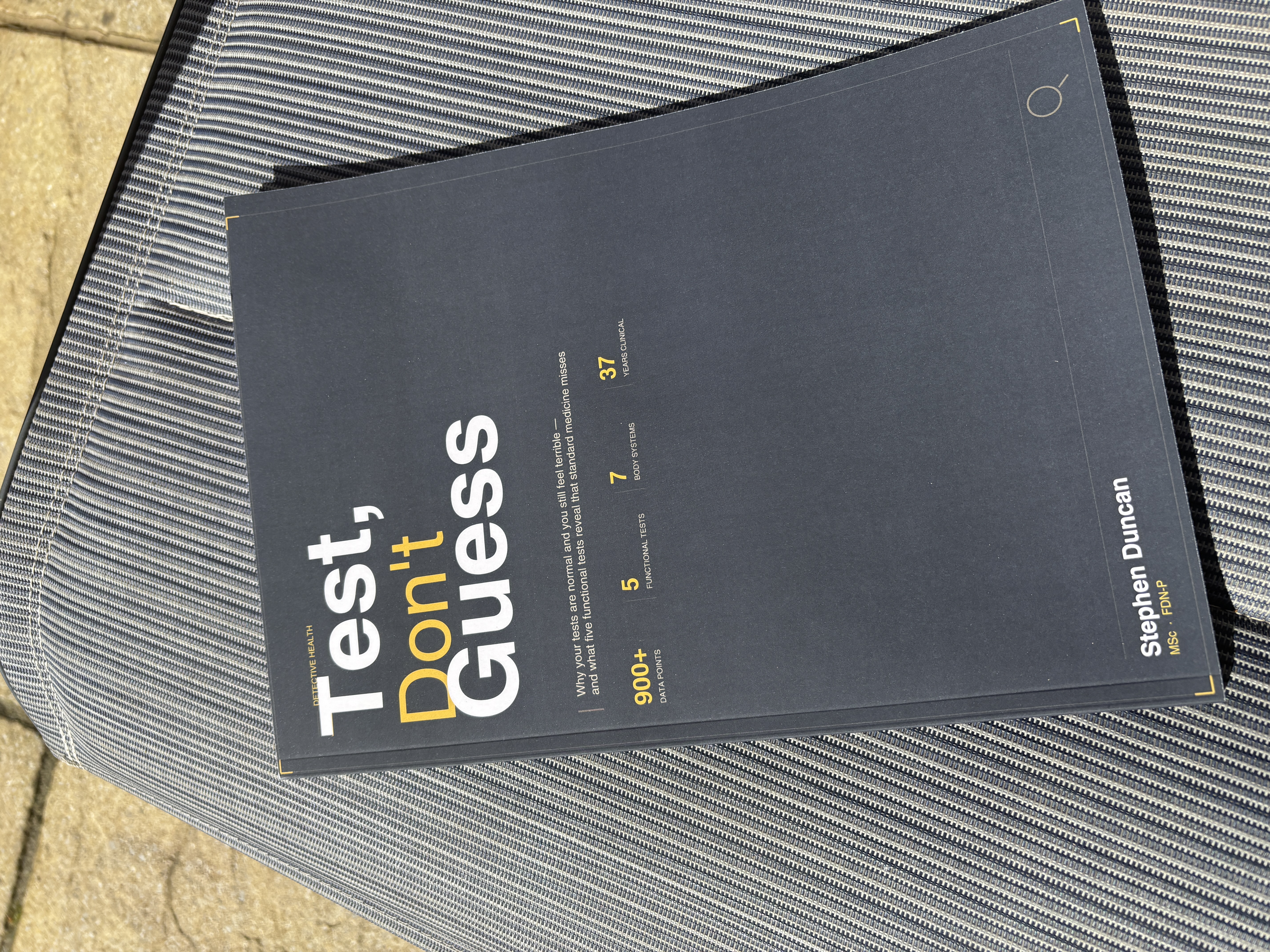
Test, Don't Guess
500+ data points. 5 functional tests. 7 body systems. Nearly forty years of experience working with people. Not theory — method.

The symptoms are messages. The tests are how you read them. And this book is the field guide that teaches you how to read them properly — with the clinical depth your GP report was never designed to provide.
Test, don't guess.