People ask me straightforward questions and I give them frustrating answers.
Should I take magnesium? It depends.
Is dairy bad for me? It depends.
Why am I so tired? Well — it depends.
I understand how that lands. So I want to explain what “it depends” actually means, because it is not hedging and it is not a sales technique. It is a description of how bodies work.
Zoom Out, Then In
Think about how you would describe a city.
From an aeroplane, it is a shape. Roads, a river, some parks. You can say useful things at this level — it is coastal, it is about two miles across — and every one of them is true and none of them tells you what it is like to live there.
From street level, you see buildings, shops, people. You could navigate. You still cannot explain why the traffic on one road is unbearable at four o’clock.
Inside a single building, you find that the lift has been broken for a month, so everyone uses the stairwell, so the side door is propped open, so deliveries come the wrong way. Now the traffic makes sense.
Medicine mostly works from the aeroplane. Organ level. Is the thyroid diseased? Is the liver failing? Is there a tumour? These are enormously important questions and the answers save lives.
But if you feel terrible and every organ is intact, the aeroplane has nothing more to tell you.
Where the Answer Usually Is
Almost everything I look at sits below organ level and above the atom.
Your thyroid can be structurally perfect and you can still be functionally hypothyroid, because the conversion of the storage hormone into the active one is happening poorly — a step requiring selenium, adequate iron, and an absence of inflammation.
Your gut can be free of disease and still not be absorbing well.
Your mitochondria — thousands per cell, making the energy for everything you do — do not appear on any standard panel at all. There is no organ called “the mitochondria” to scan.
This is the level where people actually live. And it is a level where the same complaint reliably has different causes in different people.
Six People, One Symptom
Six people tell me they are exhausted. Genuinely, persistently exhausted.
One. Iron at the bottom of the range. Not anaemic, so nobody is concerned — but iron is required by the enzymes that make dopamine and serotonin, and it carries oxygen.
Two. Converts thyroid hormone poorly. TSH looks fine, so the standard test says fine.
Three. A flattened cortisol curve. The system that should lift them in the morning has stopped producing the pattern.
Four. A gut that is not absorbing. They eat well. Very little of it arrives.
Five. Short of B vitamins — not from poor diet, but because sustained stress has been consuming them faster than they are replaced.
Six. Inflammation diverting tryptophan away from serotonin production entirely. The raw material is requisitioned upstream.
Six mechanisms. Six different corrections. Give iron to person two and you have done nothing. Give thyroid support to person four and it will not be absorbed. Give B vitamins to person six and inflammation will keep diverting the pathway.
They would all be told to try a multivitamin and get more sleep.
Nothing Moves Alone
Here is the second reason for the hedging, and the one that surprises people most. You cannot change one thing.
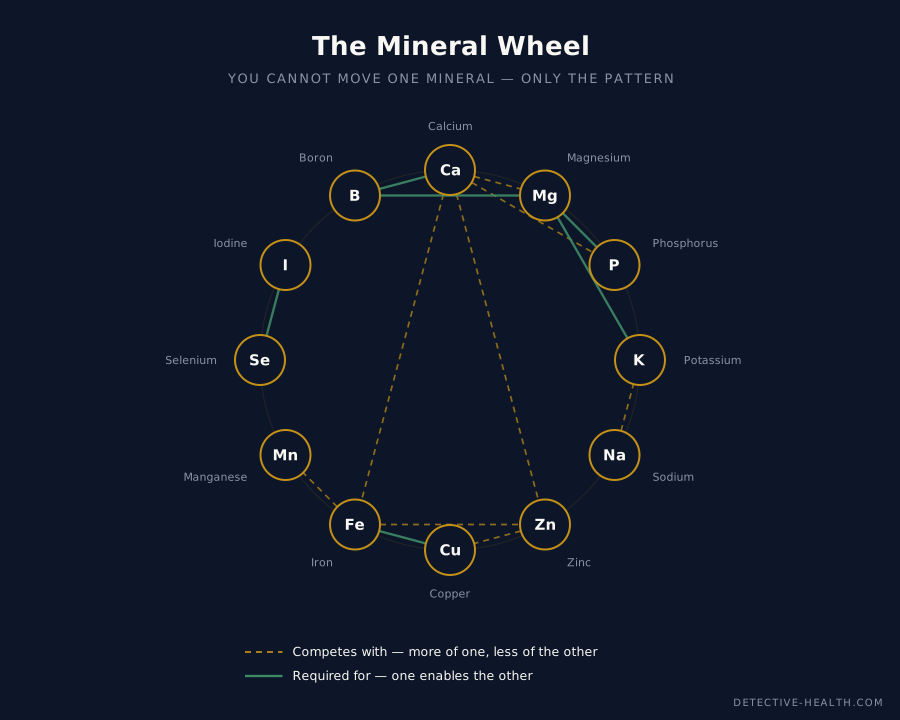
Gold dashed lines mean two minerals compete — more of one, less of the other. Green lines mean one is required for another to work.
Look at what it implies. Take high-dose zinc for your immune system and you are slowly depleting copper. Take calcium for your bones without attention to magnesium and you have shifted a ratio that governs vascular calcification as much as bone density. Take iron because a doctor said you were “a bit low” and you are competing with copper, manganese and zinc at every dose.
None of those people is doing anything unreasonable. Each is following advice that would be perfectly sound if minerals worked independently.
They do not. There is no such thing as adding one thing. There is only changing the pattern. The same is true of hormones, of neurotransmitters, of the gut. More on the wheel here.
One Bottleneck, Four Symptoms
Why do so many people arrive with anxiety and low mood and poor focus and poor sleep, all at once?
Under a one-cause-one-symptom model, that is four separate problems. But look at how these chemicals are actually made.
Serotonin is built from tryptophan in two steps. The first requires iron. The second requires vitamin B6.
Dopamine is built from tyrosine in two steps. The first requires iron. The second requires the same B6.
Noradrenaline comes from dopamine, needing copper and vitamin C.
GABA, the main calming signal, is made from glutamate by an enzyme requiring — again — B6.
It is not four independent systems. It is one production line with shared inputs.
So if B6 is depleted, you make serotonin poorly, dopamine poorly, and cannot convert glutamate to GABA. One bottleneck. Four symptoms. Which looks like four conditions and is one.
Whereas someone else with identical symptoms has adequate B6 and low iron — a different step, in the same pathways, needing a different correction.
What This Means for the Advice You’re Given
I am not arguing that everyone is a unique snowflake and nothing generalises. Plenty generalises. Sleep matters for everyone. Protein intake matters for everyone. Nobody thrives on ultra-processed food.
The argument is narrower: the more specific the advice, the less likely it is to apply to you without checking.
“Eat more vegetables” is safe general advice. “Take 30mg of zinc daily” is a specific intervention that will help some people, do nothing for others, and slowly deplete copper in anyone who takes it for two years unopposed.
The confidence in health advice runs in exactly the wrong direction. The general advice is hedged. The specific interventions — the ones that actually move your biochemistry — are delivered with total certainty by people who have never seen a single one of your numbers.
So What Do I Actually Do?
I look.
Not because testing is infallible — reference ranges have their own problems, and a marker is always a proxy for something you cannot observe directly. But a measurement taken from you is a different order of evidence from an average calculated across thousands of people who are not you.
I look at relationships rather than individual numbers. Calcium to magnesium. Zinc to copper. Sodium to potassium. Iron to copper. A person can have every value comfortably inside its reference range and still show a pattern that explains exactly how they feel.
Then I work out which bottleneck is yours, and where in the sequence to intervene — because order matters. There is no point supplying a nutrient to someone who cannot absorb it, and no point supporting a pathway that inflammation is diverting upstream.
The Honest Version
When I say “it depends”, here is the full sentence I am compressing.
Which mechanism is producing your symptom, out of the several that produce it in different people; what else in the web will move when we change this one thing; whether you can absorb what I suggest; what is upstream of the thing you have noticed; and which of those we should address first.
That is not evasion. That is the actual shape of the problem.
The people giving you a straight answer in thirty seconds are not better informed than me. They are answering a different, easier question — what works for people in general — and presenting it as an answer to yours.
Sometimes those coincide. Often they do not. And you have no way of knowing which, until someone looks.
Find out what it depends on
If “it depends” has been the answer for long enough, the next step is finding out what it depends on in your case.
Ask AIdan → See the TDG Programme