Start Here TDG Five-Test Programme Resilient Gut System Stress Programme Initial Consultation — £145 Movement & Training AIdan Products Blog Learn Clinical Diagrams Resources Beyond the Mainstream Book a Call
✦ The TDG Five-Test Programme

Five tests. Seven systems.
One protocol built around your results.

Five tests will almost always flag something, because every reference range leaves some healthy people outside it. The skill is knowing which findings matter, which to set aside, and when the answer belongs with your GP. That is what the TDG Programme is for.

5Advanced tests
5Results consultations
7Body systems
32yrTesting first
Book a free 20-minute call → How it works

The 20-minute call is free — no obligation

Why people come to TDG

You've been through the NHS route. You've had the standard blood tests. You've been told everything is normal. And you still don't feel well.

Standard medicine is good at identifying disease. It is less set up for the person whose results are in range but who still doesn't feel well. Functional testing can add leads there. Some of those leads are well evidenced and some are not, and I'll tell you which.

The conditions below are the most common presentations in the TDG programme. Most clients arrive having already spent years being investigated, reassured, and sent away without answers.

Persistent fatigue Brain fog IBS / gut dysfunction Hormonal imbalance Thyroid symptoms (normal TSH) Weight resistance Anxiety & low mood Poor sleep Autoimmune conditions Perimenopause / menopause Skin conditions Recurrent infections

Comprehensive functional investigation
across every major body system.

Each test addresses a different dimension of your health. Together they look at the same symptoms from different samples, which no single test can do. Reading them together is clinical reasoning, not a validated method, so each result is weighed against the others and against your history.

01
Comprehensive Blood Chemistry
Thyroid, metabolic, iron, inflammatory, liver, vitamin and mineral, lipid, full blood count and kidney markers, on one of three Regenerus panels chosen for you. Read against your lab's reference range, plus an evidence-graded working band where one exists — each labelled as a guideline, an outcome-based range or my own clinical target. Includes calculated ratios your standard lab report doesn't show.
57–87 markers
Regenerus Labs
02
GI-MAP Stool Analysis
DNA-based stool test reporting pathogens, parasites, digestive function, gut inflammation (calprotectin) and microbiome composition. It picks up more than a standard culture, but it also reports false positives, so anything that would be treated is confirmed through your GP first.
35+ markers
Diagnostic Solutions
03
DUTCH Plus Hormone Panel
A dried-urine hormone test: cortisol across the day plus the waking response, oestrogen metabolites (2-OH, 4-OH, 16-OH, 2-methoxy), progesterone, testosterone, melatonin, and a few organic acids that act as indirect markers of B12, B6 and glutathione status and of serotonin and dopamine metabolism.
40+ markers
Precision Analytical via Regenerus
04
Metabolomix+ (Organic Acids Plus)
Principally a first-morning urine test: organic acids related to energy metabolism, nutrient cofactors, neurotransmitter metabolism, detoxification and yeast and bacterial by-products, plus amino acids and oxidative stress markers. Add-ons, such as a finger-prick blood spot for fatty acids, are included when your case warrants them. Some of these have solid biochemistry behind them; others, such as the yeast and Clostridia markers, are weak, and the report you get from me says which is which. More on Metabolomix+
Organic & amino acids
Genova Diagnostics via Regenerus
05
HealthBeings IgG food panel (286 foods)
The HealthBeings IgG food panel (286 foods). IgG to a food mostly reflects that you eat it regularly, and allergy bodies advise against IgG testing to diagnose food intolerance. So I use the results as leads for a structured elimination and reintroduction, never as a list of foods to avoid for good: the flagged foods come out for 12 weeks, then go back in one at a time, one food every 3 days, with a symptom diary. How you respond decides, not the panel. The panel isn’t repeated afterwards, because levels fall when you stop eating a food. (One randomised trial in IBS used the 12-week trial, with mixed evidence overall; the reintroduction steps are practice.)
286 foods · IgG
HealthBeings

What each test can and can’t see.

No single test covers every system. This is the honest version: where a test measures something directly, where it only gives a clue that has to be confirmed, and where it doesn’t look at all.

Measures it directly Gives a clue, to be confirmed Doesn’t look

Swipe the table sideways to see all five tests.

Body systemBlood chemistryGI-MAP stoolDUTCH PlusMetabolomix+HealthBeings IgG food panel
Digestion and gut
Hormones and stress
Blood sugar and energy
Thyroid
Nutrient status
Immune and inflammation
Detox and oxidative stress

Blood coverage depends on the panel chosen; thyroid antibodies, fasting insulin and inflammation markers are on some panels and not others. An IgG food result mostly reflects what you eat, so it is a lead for a supervised elimination and reintroduction, never an avoidance list. A “clue” is confirmed with a second test, your history, or your GP before anything is acted on.

From symptom, to system, to test.

Five common reasons people come to me, the systems worth checking for each, and the tests that look at them. These are places to look, not causes: most symptoms have more than one possible driver, and some belong with your GP first.

Tiredness that sleep doesn’t fix
Worth checking
Iron and B12, thyroid, blood sugar, the daily cortisol rhythm, sleep
Anaemia and an underactive thyroid are common and treatable; your GP can test for both.
Tests
Blood chemistry, DUTCH Plus
Bloating and an unsettled gut
Worth checking
Digestion, gut organisms and inflammation, which foods you react to
Blood in your stool, weight loss or a lasting change in bowel habit: GP first.
Tests
GI-MAP, HealthBeings IgG food panel (286 foods) (as leads)
Brain fog or low mood
Worth checking
Blood sugar, iron, B12 and folate, thyroid, the stress rhythm
Alongside your GP and any mental health care, not instead of them.
Tests
Blood chemistry, Metabolomix+, DUTCH Plus
Weight that won’t shift
Worth checking
Insulin resistance, thyroid, stress and sleep, medications
Sleep, eating pattern and consistency come first; they have the strongest evidence.
Tests
Blood chemistry (fasting insulin, HbA1c), DUTCH Plus
Cycle, perimenopause or low-libido symptoms
Worth checking
Sex hormones and how they are processed, thyroid, iron
Heavy or irregular bleeding, or bleeding after menopause: GP first.
Tests
DUTCH Plus, blood chemistry

A structured clinical process — not a one-off consultation.

The TDG Programme is a complete clinical investigation, not a single appointment. Everything is sequenced deliberately — each phase builds on the last.

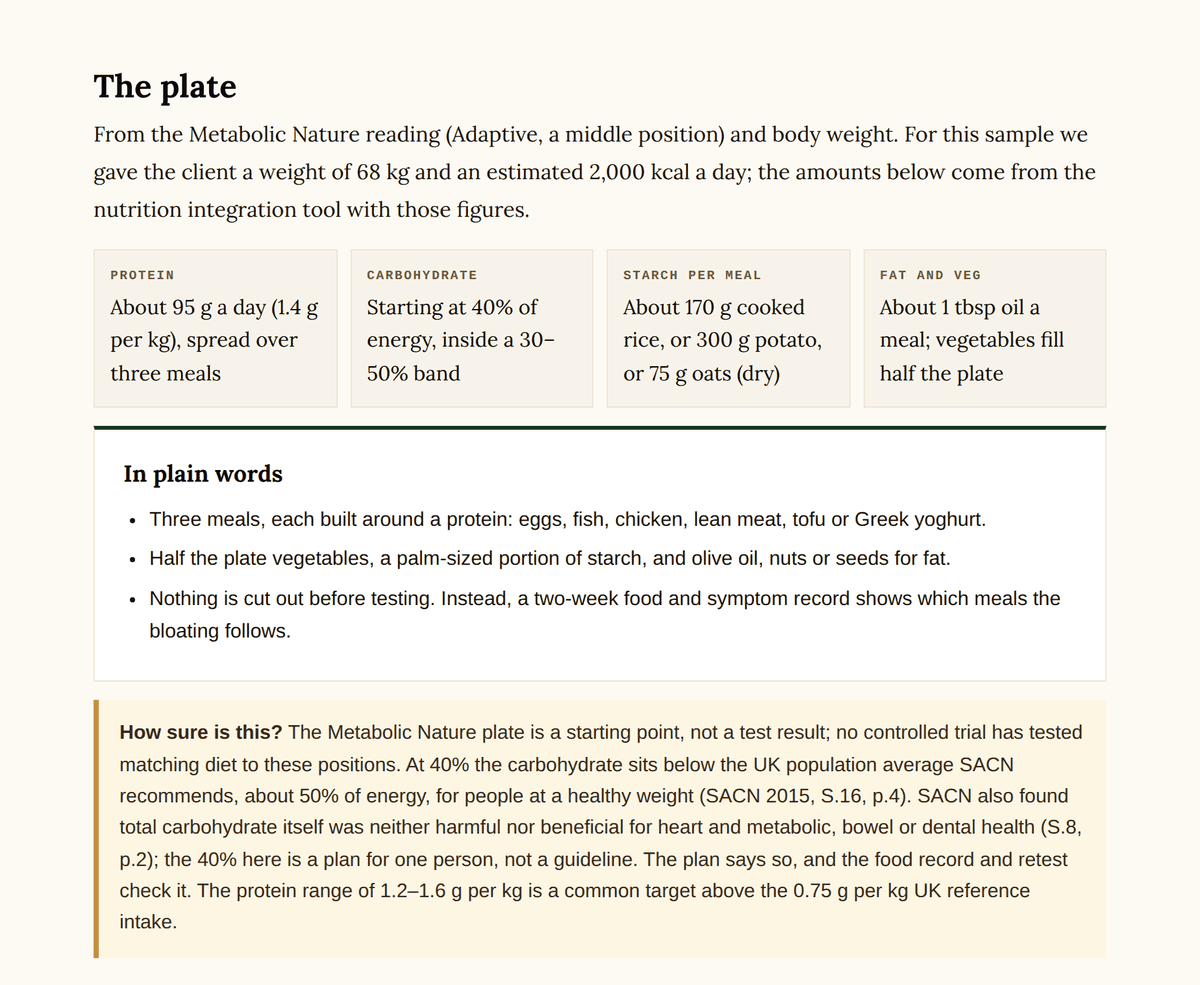
See it on one page: how the investigation fits together, then an example report and an example plan for a made-up client.
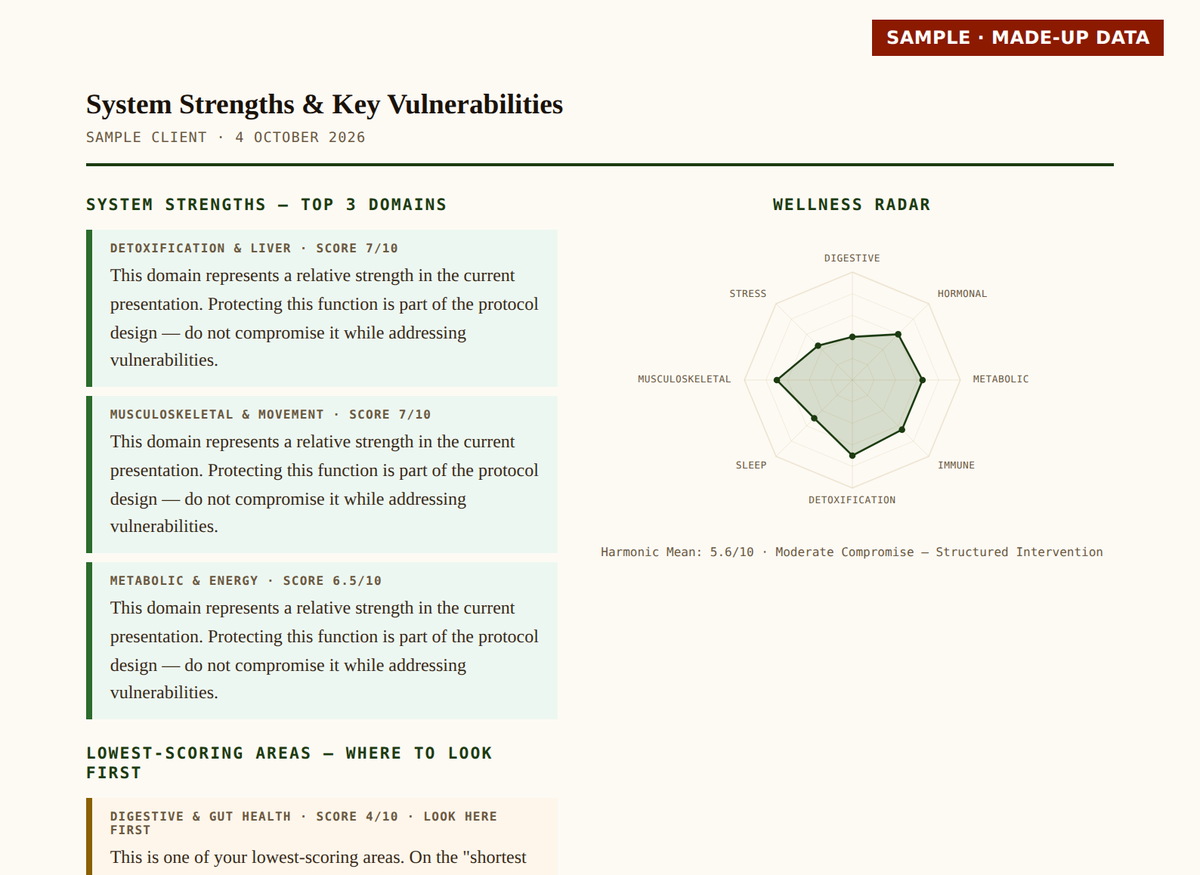
Sample Health Status Report page, made-up data: radar chart of eight body-system scores, the strongest areas and the first place to look.
Example Health Status Report
Sample written plan, made-up client: the plate, with protein, carbohydrate, starch and fat amounts, plain-words guidance and an evidence note.
Example plan: the plate
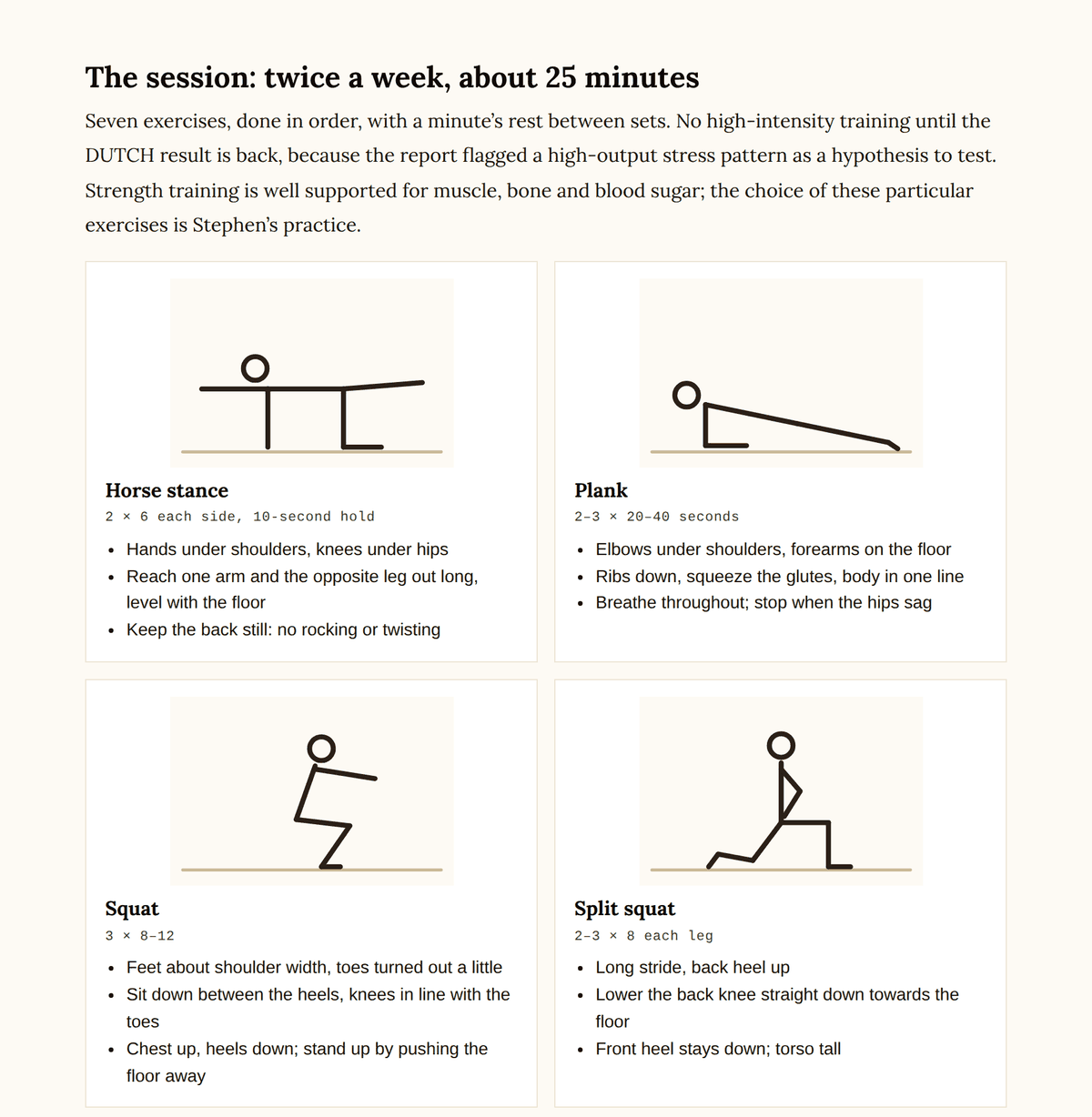
Sample written plan, made-up client: the twice-weekly 25-minute session, with drawings and coaching points for horse stance, plank, squat and split squat.
Example plan: the session
01
Free 20-minute call
Complimentary 20-minute call. We review your history, your symptoms, and confirm TDG is the right fit. No obligation.
02
Test kit dispatch
All five test kits are arranged and dispatched. Detailed instructions provided. Tests are completed at home on your schedule.
03
Clinical analysis
Results are read across all five tests and against your history: which findings agree, which to set aside, and what belongs with your GP.
04
Results consultations
A consultation with me for each test as its results come in, rather than one short call at the end. Each covers what that test shows and how it fits with the others; the last brings them together into the priority intervention sequence.
05
Written protocol
A comprehensive written protocol covering nutrition, supplementation, lifestyle, and the sequenced intervention hierarchy based on your specific results.
06
Follow-up support
Check-in consultations at 6 and 12 weeks to review progress, adjust the protocol, and plan reassessment testing. Between calls, you can message me with questions, and I add a shorter call when I think your case needs one.

The twelve conditions TDG investigates most frequently.

These are the presentations I see most often, with what is worth checking for each. Some of it is in the five tests; some of it belongs with your GP.

Persistent Fatigue
Iron status, thyroid function, blood sugar, sleep and the cortisol pattern — different causes that can feel the same.
IBS & Gut Dysfunction
Infections to confirm, gut inflammation, enzyme output and microbiome patterns — alongside the GP checks (coeliac blood test, calprotectin) that should come first.
Hormonal Imbalance
Oestrogen and progesterone metabolites and cortisol across the day, which a single blood test does not show.
Thyroid (Normal TSH)
Free T4, free T3 and thyroid antibodies alongside TSH. Antibodies can be raised while TSH is normal. A low free T3 can follow illness, under-eating or stress — a reason to look further, not a diagnosis.
Weight Resistance
Insulin resistance, thyroid function, sleep and stress — factors that can make the same diet work differently for different people.
Anxiety & Low Mood
Nutrient deficiencies worth ruling out (B12, iron, vitamin D), blood sugar and the cortisol pattern. Gut–brain links are real but mostly mechanistic, and test results support mental health care rather than replace it.
Brain Fog
Blood sugar, iron, B12, thyroid and sleep come first. Other markers can add leads, but brain fog rarely has a single-test answer.
Perimenopause / Menopause
How oestrogen is being metabolised, alongside cortisol and sleep. Whether urinary oestrogen metabolites predict risk for one person has not been established, so they inform the conversation with your GP or menopause specialist rather than replace it.
Autoimmune Conditions
Nutrient status, gut findings, stress and food leads that may be worth working on alongside your medical care. These are supporting factors, not proven causes, and the condition stays under your specialist.
Poor Sleep
Evening cortisol and melatonin, blood sugar and what happens before bed. Many sleep problems are behavioural first; testing helps when the basics haven't shifted them.
Skin Conditions
Hormonal patterns, nutrient status and food leads. Gut–skin links are an active research area, but mostly associations so far.
Recurrent Infections
Zinc, vitamin D and iron status, the cortisol pattern and sleep. A low stool sIgA is a pattern, not a measure of immunity.

This programme is designed for a specific type of person.

TDG is right for you if…
✦You have persistent symptoms that haven't been explained by standard investigation
✦You've been told results are normal but you don't feel well
✦You're ready to invest in a thorough investigation
✦You want a written protocol you can follow, not just a conversation
✦You understand this is a programme, not a quick fix
✦You're committed to implementing the protocol with consistency
TDG may not be the right fit if…
—You're looking for a prescription or GP referral (I'm not a medical doctor)
—You want a single appointment with immediate answers
—You're not prepared to make dietary and lifestyle changes
—You have an acute condition requiring urgent medical attention
—You're looking for the cheapest possible option

"Sometimes the most useful thing I can tell you is that nothing needs doing. If that's what your results say, that's what your protocol will say."

Stephen Duncan MSc FDN-P · Founder, Detective Health
Behind the Programme
Intake forms, analysis tools and a nutrition integration engine.
Every TDG consultation is built on the tools I have developed to read five tests consistently, refined by testing first since 1994. The aim is not to find as much as possible. It is to find what matters, and to say plainly what doesn't.
See what happens behind the programme →
Optional add-on · From month three

When the pattern persists, genetics usually explains why

Most of what your five tests reveal responds to intervention. Some of it does not — homocysteine that keeps climbing despite methylated B vitamins, T3 that will not shift on appropriate thyroid support, oestrogen clearance that stays sluggish however well the gut is working.

Some of those residual patterns may have a genetic component, and that is the point at which a DNA panel earns its place — not before.

Why this order matters

Genetics tells you what you are predisposed toward. Functional testing tells you what is actually happening right now. They are not the same thing, and the second is more useful.

Someone with an MTHFR variant may have perfectly adequate methylation if their diet, cofactors and gut function support it. Leading with genetics tells you about a risk that may never have been expressed. Leading with function tells you what to do on Monday.

What the panel covers

Hormone metabolism and thyroid — the oestrogen detoxification pathways, cortisol regulation, and the enzymes converting storage thyroid hormone to its active form. These sit directly alongside what your DUTCH panel measures.

Cardiometabolic — lipid handling, insulin sensitivity, inflammatory tendency and metabolic efficiency. Read against your blood chemistry.

Nutrient handling — beta-carotene to vitamin A conversion, B12 absorption, the vitamin D pathway, omega-3 metabolism, iron regulation, lactose tolerance. This is the layer that explains why two people on the same diet end up with different nutrient status.

Neurotransmitters and circadian rhythm — the dopamine and serotonin architecture, and the clock genes governing sleep timing. Read against your organic acids results.

What genetics is not

A variant is a predisposition, not a diagnosis and not a destiny. Most of what these genes describe is modifiable by what you eat, how you sleep, and what your gut is doing. That is the whole point of running the functional tests first.

One caveat worth stating plainly: the panel includes APOE, which carries information about long-term dementia risk. Some people want to know and some emphatically do not. We discuss that before the test is ordered, not after, and you can choose not to receive that section.

When: at your three-month retest, or once the functional picture has stabilised.

How: a saliva sample collected at home. One sample covers all reports.

Cost: £150 for the panel, plus £50 per interpretation report. Four reports are available — £350 for the complete picture. Discussed and agreed at your retest consultation, never added automatically.

Existing clients: ask AIdan about the DNA add-on, or raise it at your next consultation.

The investment

The TDG Programme is a comprehensive clinical investigation. The fee covers everything — all five test kits, laboratory coordination, clinical analysis, a consultation for each test, written protocol, and follow-up support. Nothing is additional.

TDG Five-Test Programme
£3,500
All five test kits are arranged, coordinated and included, along with laboratory fees, couriers and your blood draw (unless you’ve arranged your own). You do not deal with laboratories separately. Part of what the fee pays for is choosing the right version of each test, any add-ons, and the consultations your case needs, so the programme is partly bespoke rather than one fixed bundle. Instalments available — ask on your free call.
✦Free 20-minute call
✦All five test kits arranged and coordinated
✦Full clinical analysis across all five tests simultaneously
✦A consultation with Stephen for each test as its results arrive
✦Comprehensive written clinical protocol
✦Follow-up consultations at 6 and 12 weeks
✦Messages between calls, and shorter calls when your case needs them
What makes it different
✦One practitioner throughout: the person who reads your results is the person you speak to
✦A proper consultation for each test, not a short call once everything is back
✦Five tests read together and against your history, not five separate lab reports
✦The right version of each test, with add-ons only when your case warrants them
✦Findings sorted into what matters, what to set aside, and what belongs with your GP
✦Testing first since 1994 behind every reading
✦Honesty first: every recommendation graded against the evidence, and a public corrections page when I change my mind
Book your free 20-minute call →

The 20-minute call is free and without obligation

Not ready for the full programme? The interpretation guides are a self-guided starting point at £197 each — or speak to us about the Resilient Gut System programme.

Working with people since 1988. Testing first since 1994.

Stephen Duncan
MSc · FDN-P · Edinburgh
MSc Coaching Studies & Applied Physiology
Functional Diagnostic Nutrition Practitioner (FDN-P)
Reed Davis FDN Model
Bill Wolcott Metabolic Typing (Healthexcel)
Bryan Walsh Blood Chemistry
Paul Chek Movement Framework
Co-founder, Omnos functional lab platform
Founder, Detective Health
FDN-P Certification Badge
FDN-P Certified
Advanced Heart Wellness Badge
Advanced Heart Wellness

I started in athletics and boxing coaching before spending nearly four decades working with clients whose symptoms were real but whose investigations kept coming back normal. That gap — between feeling unwell and getting an explanation — is what the TDG programme was built to close.

The Test, Don't Guess philosophy is not complicated. You cannot optimise what you haven't measured. You cannot address root causes you haven't identified. And you cannot build a credible protocol from a single test viewed in isolation.

Every protocol I produce is built from the intersection of five test results, viewed through seven body systems, informed by nearly forty years of working with people. There is no template. Everything is specific to your results.

Before you apply.

How long does the programme take?
From the first call to written protocol is typically 6–8 weeks — most of that is waiting for test results. There is a consultation with me for each test as its results come in, then follow-ups at 6 and 12 weeks. The implementation phase runs 3–6 months.
Do I need a GP referral?
No. All tests are arranged privately and directly. You don't need a GP referral, and you don't need to have seen a doctor first. That said, TDG doesn't replace your GP — we work alongside conventional medicine.
Are the consultations in person or online?
All consultations are conducted via video call. Clients are based across the UK and internationally. Test kits are posted directly to your address regardless of location.
What if my results come back relatively normal?
Then that's what I'll tell you. Five tests will almost always flag something — around one result in twenty sits outside a reference range by chance alone — so part of my job is telling you which findings matter and which don't. If nothing needs doing, your protocol will say so, and if your symptoms need a different route, I'll say that too. More on this: The Test Isn't the Investigation.
Is the programme suitable for men as well as women?
Yes. The programme is appropriate for any adult experiencing persistent symptoms. The test panels and reference ranges are fully sex-specific where clinically relevant.
What happens after the 12-week follow-up?
Most clients continue with a reassessment protocol — retesting the most relevant markers at 6–12 months to confirm progress and refine the approach. Ongoing support is available as needed.

Ready to find out what's
actually going on?

The 20-minute call is free and without obligation. It's a conversation — we review your history, your symptoms, and establish whether TDG is the right next step for you.

Book your free 20-minute call →

20 minutes · No obligation · Online via video call

AIdan

Have a question before you commit?

Ask AIdan about the programme, the tests, or how functional testing works. For anything about your own case, the free call is the place.

Clinical education tool — not a diagnostic service. Open full concierge →